Get to Work!
All the maxims have been written. It only remains to put them into practice.
Blaise Pascal
Although the agile transformation of BMW Group IT triggered this Manifesto and its principles, much of it had already been known for decades. Agility and the associated trend towards more self-organization and leadership at eye level are only a welcome opportunity to demand once again a more “species-appropriate keeping” of knowledge workers and to finally implement Peter Drucker’s postulates (see Section “Species-Appropriate Keeping of Knowledge Workers”). If those insights on new leadership are not so new, what blocks us from implementing them? What do we need to make this change happen? Where should we start?
Leading by Example
Albert Schweitzer embodied this principle convincingly throughout his life: “Leading by example is not only the best way to influence others, it is the only way.” True authority is not a question of position but of exemplary behavior. Leadership is based more on imitation than submission. We could save ourselves a lot of resistance, fights, and suffering in our organizations and families if we first truly embodied the change we want to see in our environment. Only those who can lead themselves with sincerity and authenticity will gain the trust to lead others by example.
The following story about Mahatma Gandhi is not proven, but it is no less inspiring. A woman came from far away with her son to see Gandhi. She was worried because her son overindulged sugar and was in danger of getting sick.
So she waited patiently for many hours, and when it was finally her turn, she said, “Please, Master, tell my son to stop eating sugar.” Gandhi looked into the boy’s eyes and replied to his mother: “Bring him back to me in two weeks.”
Dissatisfied, the woman traveled home and returned two weeks later. When they went before Gandhi this time, he said: “Boy, you must stop eating sugar.” Out of respect for Gandhi and his wisdom, the boy promised to stop eating sugar and has led a healthy life ever since.
But the mother was confused and asked Gandhi: “Why didn’t you tell my son this two weeks ago?” Gandhi replied: “Two weeks ago, I still ate a lot of sugar myself. I had to stop first.”
Who would have acted like Gandhi in this story? Who would not have fallen into the trap of “working off” the petitioners? Who would not immediately have given the powerless, inauthentic advice without consciously reflecting on their own behavior? How do we behave day in and day out when working through our emails, in meetings, or towards our children? How does this behavior match our beliefs, intentions, and words?
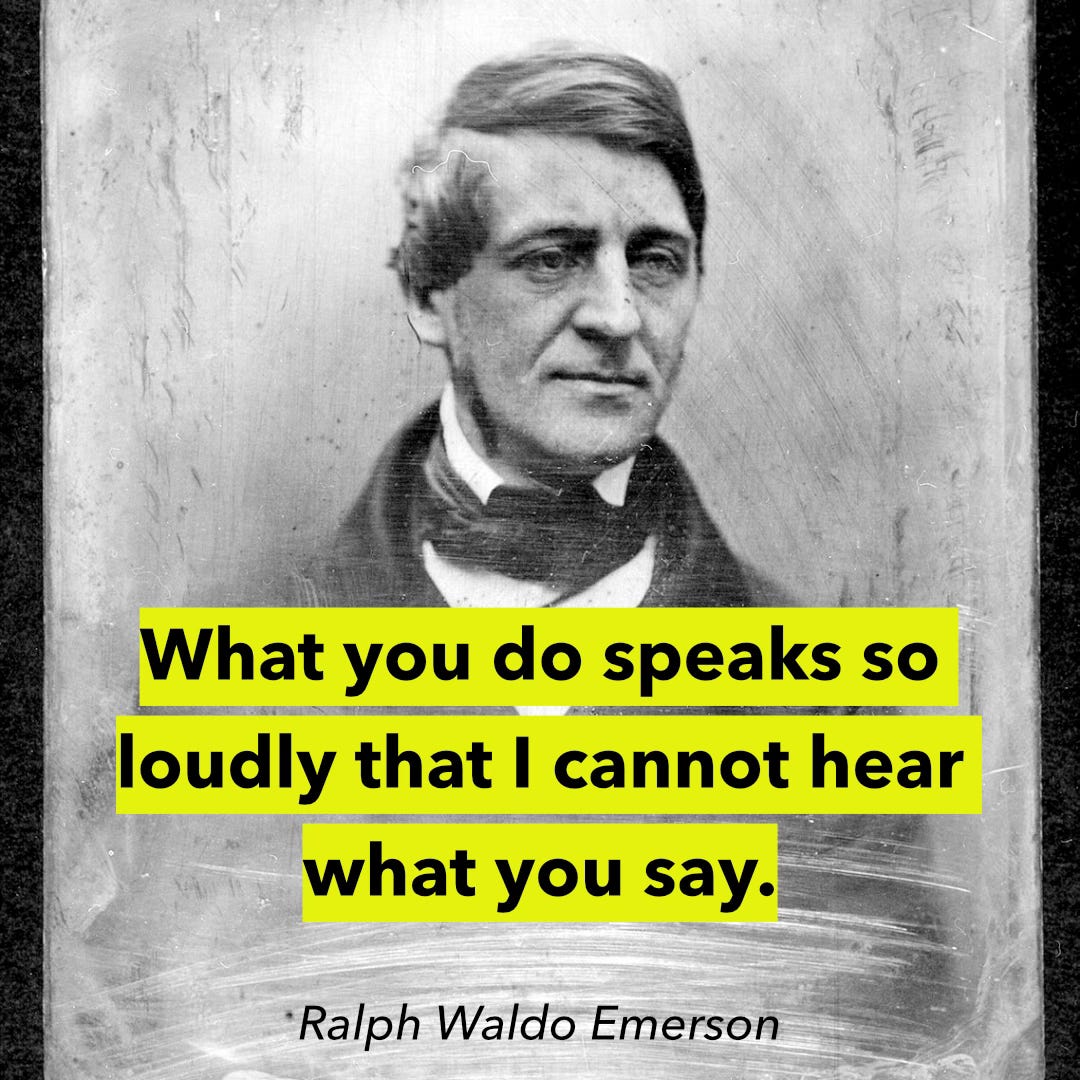
Major disruptions and transformations characterize our times. For these to succeed and not fizzle out as ineffective change theater, leadership by example is the key. No one should believe that it is only about changing others—primarily the “subordinates”—while their own role remains untouched. Or worse still, no one should see those changes as a way to expand their position of power predominantly. Leadership is much more effective through behavior than through language, or in the words of Ralph Waldo Emerson: “What you do speaks so loudly that I cannot hear what you say.”1 So, let’s lead courageously and authentically and embody the change we want to see in the world.
Incitement to Rebellion
Winston Churchill was unambiguous: “Without courage, all virtues lose their meaning.” Not only socially and politically, we need courage more urgently than we have for a long time; our companies and the people who work there would also benefit from an extra dose of courage. Hierarchy as the dominant building principle and the absolutist power of position holders is increasingly being complemented and replaced by a network based on meritocracy (see Section “Network and Hierarchy”). Our companies, therefore, need a new enlightenment with a more consistent separation of powers. Immanuel Kant’s motto should stand above every gate: “Have the courage to use your own intellect!”
It takes courage to let go and lead indirectly as a gardener. The perceived loss of control will and should make you nervous; otherwise, it was not enough to quote Lazslo Bock again (see Section “Principles Not Rules”). Conversely, it also takes courage to make use of the new freedom; making your own decisions means taking responsibility and taking risks. In a culture of psychological safety, this can unleash unimagined potential. This new freedom is definitely motivating, but it was more comfortable and less risky to pass responsibility onto the “stupid boss.”
It is hardly surprising that courage is not just one of nine (quite interestingly formulated) values in the Netflix Culture Statement mentioned before but also occupies a distinctive position as a corrective. The courage to openly address inconsistencies between the postulated and practiced values is essential:2
We work hard to keep each other accountable for upholding these standards, especially our leaders, because excellence and honesty go hand in hand. It’s why we invest in strong professional relationships that build trust and help people assume good intent. This, in turn, enables us to practice extraordinary candor—ensuring constructive feedback is part of our everyday work (like brushing your teeth). It takes courage and vulnerability to ask someone how you could do better, or to seek alternative opinions, and integrity only to say things about a colleague you’re willing to share with them directly.
This permission to courageously address digressions from the desired culture gives all employees at Netflix the proverbial “fool’s freedom” with which court jesters in the Middle Ages were endowed to be able to address the moral failings of the leaders. This corrective element keeps the leaders accountable and makes the decisive difference to the glorious formulations of many organizations’ canons of values, often perceived as empty or unrealistic because they are at odds with actual behavior.
Where this explicit permission is lacking, it is still allowed to use one’s intellect in the spirit of Immanuel Kant’s motto. Aristotle said, “A good person is not always a good citizen.” The same applies today: a good employee is not always a conformist or obsequious employee. Change needs disturbance by people who critically question the status quo. They can rely on the concept of civil disobedience, as many self-proclaimed organizational rebels do. They identify with their organization and the actual purpose of this organization, but not with incoherent rules and patterns of behavior or an organizational culture that is perceived as obstructive to this purpose. They do not work against the organization; instead, their rule-breaking and constructive questioning aim at improving the organization. By thinking and acting differently, they protect organizations from complacency and inertia (see Section “Disturbing the Comfort Zone”).
Leaders who want to encourage rebels consciously promote diversity and dissent and create a safe space in which questioning the status quo is desired and appreciated. This space extends beyond the manager’s actual area of responsibility. In the jungle of corporate politics, there are enough pitfalls that trigger an immediate and more or less harsh immune reaction of the system against troublemakers. The leader’s job is to recognize and avoid these pitfalls and thus protect their rebels, which makes them rebels themselves.
Rebels need freedom to question the status quo and try out something new. Things get even better when not just a few select rebels have this freedom but as many as possible so that rebellious ideas can resonate in the organization. Everyone should be free to try things out and learn without getting lost in the mills of politics. Everyone should be free to think outside the box and question the status quo. And everyone should feel empowered and encouraged to make use of this freedom.
Set Priorities
Evolution has endowed humans with the astonishing ability to anticipate future states with our minds, commonly known as planning. This ability, combined with our linguistic skills, which enable us to plan and execute things together, is a great blessing for humanity. Yet, for the individual, it can also be a curse. The ability to think in scenarios also gives rise to a plethora of demands, wishes, and conflicts. It is never enough; there is always more to try and achieve. The French mathematician and philosopher Blaise Pascal summed up this tragedy of human existence aptly and somewhat resignedly: “All of humanity’s problems stem from man’s inability to sit quietly in a room alone.”3
The complaint about the brevity of life against the backdrop of our endless possibilities, wishes, and demands is as old as humanity itself. However, thinkers and philosophers seem to be particularly affected by this problem. Seneca, for example, starts his book “On the Shortness of Life”4 with this quote:
Most human beings complain about the meanness of nature, because we are born for a brief span of life, and because this spell of time that has been given to us rushes by so swiftly and rapidly that with very few exceptions life ceases for the rest of us just when we are getting ready for it.
Since ancient times, the gap between conceivable possibilities and the time available for them has widened for more and more people. Modern and post-modern humans face almost infinite possibilities and are entrusted with the once divine task of giving meaning to their bare existence. At first glance, the roughly 4,000 weeks available to each of us on average seem like a bad joke from a cruel creator, as Oliver Burkeman pointedly stated:5 “The average human lifespan is absurdly, terrifyingly, insultingly short.”
We can envision a lot in theory and hope for a lot, but we can only put so little of it into practice. No matter how well we organize ourselves, how perfectly our time management systems work, how early we get up, or which morning routine we use, we can only ever implement a tiny fraction of the possibilities. However, exactly this natural limitation of our capacity makes our decisions meaningful; if we had infinite time, our choices wouldn’t matter much. The selected option gains significance only when the one yes inevitably means a multitude of no’s. “The quality of our yeses is dictated by the quantity of our noes,” Greg McKeown aptly put it in his podcast.6
Therefore, time management and productivity cannot aim at getting everything done. Instead, it must be about making deliberate decisions. As a decision to do something always confronts us with opportunity costs and ultimately our finiteness, we only make it when it has become inevitable. We fill our days until it hurts, and only in this overload situation do we dare to turn down tasks and opportunities. This is why Cal Newport sees most knowledge workers permanently in a borderline area of overload:7 “They instead exist in a liminal zone: a place where they toil, say, for the sake of fixing a specific number, twenty per cent more than they really have time for. This extra twenty per cent provides just enough overload to generate persistent stress. There’s always something late, always a message that can’t wait until the next morning, and always a nagging sense of irresponsibility during any moment of downtime. Yet the work remains below unsustainable pain that would force a change.”
So we can say no but only dare to with a pure conscience when overloaded. In light of Oliver Burkeman’s very liberating thought that we won’t get the vast majority of things done in our lives anyway, twenty percent more or less doesn’t make a significant difference in the long term, even more so if it is used so indiscriminately, as happens every day in our calendars and mailboxes. What makes a difference is choosing wisely. We need a certain amount of space and a buffer to make these choices deliberately. If we start to select when we are already on the verge of this painful overload, this choice is arbitrary because we are not guided by priorities but simply reject options due to overflow.
Our optimal utilization is, therefore, not twenty percent overload, even if that feels so pleasingly “busy,” but rather eighty or eighty-five percent. As a mathematician, Gunter Dueck derives this limit from queueing theory and comes to this recommendation in summary:8 “Anything over eighty-five percent utilization leads to chaos and even disaster. This is because such a high workload generates new work through nuisance and changes in priorities due to waiting emergencies so that the workload rises above one hundred percent and causes the system to collapse.”
However, the 4,000 weeks allotted to us are not nothing; they are a miracle in themselves; if used wisely, we can achieve a great deal within them. Time management does not mean squeezing as much as possible into the time available time (efficiency) but ultimately saying yes to the right things and consequently saying no to many others (effectiveness). Unfortunately, our ability to mentally anticipate future conditions makes many things seem attractive and desirable, so every choice comes with high opportunity costs. But precisely because our time is so frustratingly limited, we must not sit paralyzed, like a rabbit in front of a snake, but must make a good choice.
To make this choice amidst the daily chaos, we should heed the practical advice that Warren Buffett is said to have once given his pilot regarding how to set priorities in life. Buffet advised him to list twenty-five things he wanted to achieve and rank them in descending order of importance. The top five would then form the priorities according to which he should organize his life. However, he should not treat the other twenty as subordinate priorities that he could tackle if the opportunity arose but should avoid them at all costs. On the one hand, these other ambitions are not important enough to form the core of his life, but on the other hand, they are seductive enough to distract him from the essential things.9
Enduring Dissonance
A few years ago, a CIO and head of a corporate IT department with around 5,000 employees worldwide, responsible for an annual budget of hundreds of millions of euros for external services, told me in passing that he saw himself also as a middle manager. This may have been his justification for why he could not take any further action in the matter presented to him (supporting the Working Out Loud movement). However, this comment also shows the tension between aspiration and reality in which many leaders find themselves today.
On the one hand, they have found a suitable leadership philosophy for themselves or are actively working on it and strive to lead their area of responsibility accordingly. On the other hand, they are part of a larger system and thus embedded in less modern or at least differently shaped structures and processes. In many cases, their dreary everyday life in the company will likely remind them of this sobering summary by the German economist Knut Bleicher:10
We work in yesterday’s structures with today’s methods on strategies for tomorrow, mainly with people who created yesterday’s structures and who will not experience the day after tomorrow in the company.
It is one thing to develop a coherent modern leadership philosophy for oneself. However, enduring the tension between this aspiration and the harsh reality of day-to-day management in mostly traditional structures is something completely different. This cognitive dissonance, i.e., the incongruence of beliefs and reality, has already been described in Section “He Who Says A Does Not Have to Say B.” We tend to resolve those conflicts like the fox in Aesop’s famous fable, who doesn’t want to admit that he can’t reach the grapes and therefore claims that they are sour anyway and that he doesn’t want to get them. Problem solved.
The cognitive dissonance between aspiration and reality arises for modern leadership in two directions: On the one hand, between the gardener’s attitude, which provides the framework conditions for the development of human potential, and the often conflicting demands of the organization, for which good leadership primarily means having a firm grip on one’s store like a chess master. On the other hand, not all people are immediately willing and able to accept the newly granted freedom and the responsibility that comes with it. Hence, to the gardener’s embarrassment, the garden often produces more weeds than fruit at first.
To make matters worse, both areas of tension reinforce each other. The initial disappointment with employees who don’t pull their weight as expected is exacerbated by the malevolence of other managers and the request from the boss to get their store in order finally. This dissonance is difficult to bear, and it is not uncommon for initially ambitious leaders to resign themselves to their fate and lead people as they seem to deserve it and as the organization expects them to manage their shop.
However, correcting one’s convictions and aspirations and ultimately distorting oneself is just one way to mitigate this dissonance—certainly not the most fulfilling and healthy one. Adding new consonant cognitions is a better way to deal with this dissonance. The factual day-to-day management experience may be disappointing and frustrating at first, but not always and everywhere. However, these rays of hope are easily buried under the avalanche of all the things that don’t work as desired. Recognizing these bright spots, consciously highlighting them, and celebrating them helps immensely. Sometimes, it is also worth looking over the fence of your own organization into the garden of other companies and leaders, either through personal exchange or at least by reading the relevant literature.11
Doing Your Best
Perhaps the Stoics’ philosophy of life is being rediscovered because of these turbulent times we live in, making us undoubtedly feel powerless. Stoicism differs from many other schools of philosophy in that it is very close to life and practical. The Stoics were always concerned with leading a good and meaningful life. To this end, Stoicism offers numerous timeless considerations and practical guidance.
“God, grant me the serenity to accept the things I cannot change, the courage to change the things I can, and the wisdom to know the difference.” What the American theologian Reinhold Niebuhr asks for in this well-known Serenity Prayer, particularly the wisdom to distinguish between things within our control and those over which we have no power, is a central practice of the Stoics. Epictetus, for example, writes right at the beginning of his famous handbook: “Some things are up to us and some are not up to us.”12 As a Stoic philosopher, he was concerned with distinguishing clearly between those two categories so that we can focus our attention on the things over which we truly have power. He then continues and gives examples of both categories: “Our opinions are up to us, and our impulses, desires, aversions—in short, whatever is our own doing. Our bodies are not up to us, nor are our possessions, our reputations, or our public offices, or, that is, whatever is not our own doing.”

Beginning of the “Handbook” by Epictetus, Greek-Latin edition with commentaries by Abraham Berkel, 1683.
Modern, career-oriented people tend to disagree with Epictetus reflexively and intuitively see wealth, prestige, and office as being in their power. After all, that is what our meritocracy is all about. But are these things entirely within our control? This may be the flaw in thinking that causes many people to become dissatisfied or even burn out.
The dichotomy Epictetus suggests is, in fact, a trichotomy. In addition to the things that are entirely under our control, we need to further distinguish between things over which we have no control and those over which we have at least partial control.13 It stands to reason that it is pointless and detrimental to our peace of mind to get worked up about things that we cannot influence. The weather is a popular, albeit harmless, example of this category. More worrying are things like the outbreak of a pandemic or war, over which we have no control. Stoic art is to face these uncontrollable circumstances calmly, to accept them in a backward-looking way, and yet to actively shape life, society, and the future in a forward-looking way.
The Stoics were not lethargic hermits without worldly ambitions but were often intensely and successfully involved in society and politics. Marcus Aurelius, the most important representative of the younger Stoics, was one of the most influential Roman emperors. Cato the Younger’s inclination to Stoicism did not hold him back from “fighting bravely to restore the Roman Republic.” More evident is this pattern with Seneca: “Besides being a philosopher, he was a successful playwright, an advisor to an emperor, and the first-century equivalent of an investment banker.”14
So how does it fit into the stoic worldview to concentrate only on the things over which we have power on the one hand and yet be highly successful in areas that are beyond our control? The answer lies in the third category of things, i.e., those over which we have some influence. The outcome of a tennis match is not entirely within our control, but we are not completely powerless either. On the one hand, we can train to the best of our ability, and on the other, we can positively influence the outcome by trying to perform at our best. If we still lose the match, our peace of mind is not threatened because we have nothing to blame ourselves for.
The goals we set ourselves make all the difference. Training to the best of our ability and playing as well as possible is entirely within our control, but winning the match is not. Training, motivation, and concentration during the game will help us win, but many other factors outside our control stand in the way. The same applies to the things listed by Epictetus, namely “our possessions, our reputations, or our public offices.” We can and should choose goals that are entirely within our control and positively impact those aspirations outside our control.
“By internalizing his goals in daily life, the Stoic is able to preserve his tranquility while dealing with things over which he has only partial control.”15 This wise focus on goals within our power is the crucial link between ambition and serenity. This attitude is particularly helpful when it comes to enduring the tension described in the previous section between our own aspirations and values and those of the surrounding organization and its culture. Much of this is beyond our direct control and influence as a leader. To aim for this would mean tilting at windmills like Don Quixote. Nevertheless, we can set ourselves goals within our power and do our best to embody the change we want to see in the organization with sincerity and courage.
-
“What You Do Speaks So Loudly That I Cannot Hear What You Say – Quote Investigator®,” January 27, 2011, https://quoteinvestigator.com/2011/01/27/what-you-do-speaks/. ↩
-
Netflix, “Netflix Culture,” accessed March 20, 2022, https://jobs.netflix.com/culture. ↩
-
Blaise Pascal and J.F. Kleuker, Gedanken (bei Johann Heinrich Cramer, 1777), 221. ↩
-
Lucius Annaeus Seneca and Charles D. N. Costa, On the Shortness of Life, Great Ideas 1 (London: Penguin Books, 2004), 1. ↩
-
Oliver Burkeman, Four Thousand Weeks: Time and How to Use It (Random House, 2021), 3. ↩
-
Greg McKeown, “Identifying Your Circle of Competence with Kyle Westaway (Part 2),” The Greg McKeown Podcast, accessed September 1, 2023, https://gregmckeown.com/podcast/episode/identifying-your-circle-of-competence-with-kyle-westaway-part-2/. ↩
-
Cal Newport, “Why Do We Work Too Much?,” The New Yorker, August 30, 2021, https://www.newyorker.com/culture/office-space/why-do-we-work-too-much. ↩
-
Gunter Dueck, Schwarmdumm: so blöd sind wir nur gemeinsam (Frankfurt am Main: Campus-Verl, 2015), 61. ↩
-
Burkeman, Four Thousand Weeks, 77f. ↩
-
St. Gallen Business School, “Knut Bleicher - St. Galler Business School,” 2017, https://sgbs.ch/ueber-uns/management-valley-st-gallen/knut-bleicher/. ↩
-
Frédéric Laloux and Ken Wilber, Reinventing Organizations: A Guide to Creating Organizations Inspired by the Next Stage of Human Consciousness, First edition (Brussels: Nelson Parker, 2014); Bodo Janssen, Die stille Revolution: Führen mit Sinn und Menschlichkeit, 7. Auflage (München: Ariston, 2016); Laszlo Bock, Work Rules! Insights from inside Google That Will Transform How You Live and Lead, First published in paperback (London: John Murray, 2016); Jason Fried, David Heinemeier Hansson, and David Heinemeier Hansson, ReWork: Change the Way You Work Forever (London: Vermilion, 2010). ↩
-
Epictetus, Handbook of Epictetus, trans. Nicolas White (Indianapolis/Cambridge, 1983). ↩
-
William Braxton Irvine, A Guide to the Good Life: The Ancient Art of Stoic Joy (Oxford: Oxford University Press, 2009), Kindle-Edition, 85ff. ↩
-
Irvine, A Guide to the Good Life. ↩
-
Irvine, A Guide to the Good Life. ↩