Persistent in Efforts, Modest in Expectations
The yearning for a new and better form of cooperation where we can create value not just despite but because of valuing people is greater than ever. Taylorism and industrialization have degraded people to resources. Back then, only the labor of the unskilled worker was in demand, and Henry Ford once complained that he always got a brain when asking just for a pair of hands. In our age of knowledge work, people’s roles, qualifications, and demands have differentiated in many ways. However, the basic principle of viewing and running organizations as machines and treating employees as cogwheels has remained unchanged.1
I Have a Dream
I have this dream of a new and better working world.
I have the dream that the economy will someday serve people and life and vice versa.
I have the dream that people are seen as the ends of economic activity, not just the means of it.
I have a dream that we put the miserably failed attempt to motivate people with incentives on the shelf and instead build organizations that do not demotivate people to the extent that they need external motivation.
I have a dream that people will no longer be used as resources but that the development of individual potential will be seen as a decisive competitive factor.
I have this dream every day.
Let’s dream together. Let’s create a new and better world of work step by step. And let’s build humane organizations for the age of digitalization. “Persistent in our efforts, modest in our expectation of success,” quoting the wise life motto of Götz W. Werner, founder of the German dm drugstore chain.2
Enabling Self-Leadership
In a world in which it is “normal that many things have become different and are becoming more different faster and faster,” as the business education teacher and time researcher Karlheinz A. Geißler aptly put it3, the role of leadership is, at the very least, up for discussion.
Leadership is not about you and your ego but making others successful. For Götz W. Werner, leadership was only legitimate in enabling self-leadership4. Leadership is an attitude, not a position. This book describes this attitude and the principles of new, agile, digital, and, above all, humane leadership.
As mentioned in the introduction, I created the six theses forming the core of this Manifesto for Humane Leadership in 2018 during BMW Group IT’s agile transformation. They were my first attempt to answer how leadership needs to change to enable empowerment and self-organization as the foundational elements of true agility.
However, in hindsight, this transformation journey was just a welcome opportunity to breathe new life into long-standing concepts of servant leadership. Over time, this book became my idealistic and perhaps naïve attempt to create organizations and working environments that are more “species-appropriate” for knowledge workers.
The starting point amid BMW Group IT’s agile transformation also explains the specific form of my Manifesto for Humane Leadership, which is deliberately based on the seminal “Manifesto for Agile Software Development.”5 The goal of this format is to avoid black-and-white thinking in favor of areas of tension and growth, such as “Individuals and interactions over process and tools,” where both sides are valuable, but the first mentioned should be given more weight here and now.
This Manifesto for Humane Leadership draws from Peter Drucker’s groundbreaking contributions on the nature of knowledge work and the leadership of knowledge workers, as well as on the positive human image in Theory Y from Douglas McGregor’s much-neglected book “The Human Side of Enterprise”6. Therefore, the title can and should be understood as an allusion to this human side of organizations and collaboration.
Species-Appropriate Keeping of Knowledge Workers
More than half a century has passed since Peter Drucker coined the term knowledge work in 1959.7 Knowledge work means to think up and create something new. Knowledge workers use their knowledge, experience, and creativity to generate new insights. They carry their means of production in their heads and are, therefore, much more independent than the workers on the assembly line in the days of Frederick Winslow Taylor.
Back then, the manager was the expert whose task was to use unskilled workers’ labor as productively as possible. That dehumanized the workers into interchangeable cogs in a gigantic machine and made them dependent on their workplace on the assembly line. They required the factory owner’s means of production to trade in their labor for money. With knowledge work, things have been turned upside down. Now the organization depends on knowledge workers, who can easily take their means of production with them.
Around the same time when Peter Drucker introduced knowledge work, Douglas McGregor questioned Taylorism’s negative view of people and called for a much more positive one. He recognized that the assumption of the prevailing Theory X, that people are lazy and need to be motivated to perform, is detrimental to knowledge work. Theory Y, which sees people as motivated and willing to perform, is much more helpful.8 If people are unwilling to perform in the organization, this is often a systemic problem, not a human one. We need to fix the system, not the people.
Peter Drucker postulated that knowledge workers must be led at eye level long before this term became fashionable. To him, leadership is an equally important function necessary for making a group of people or an entire organization successful. In knowledge work, the relationship between worker and manager is no longer characterized by subordination but is transformed into a relationship of cooperation–very much like in an orchestra9:
Their relationship, in other words, is far more like that between the conductor of an orchestra and the instrumentalist than it is like the traditional superior-subordinate relationship. The superior in an organization employing knowledge workers cannot, as a rule, do the work of the supposed subordinate any more than the conductor of an orchestra can play the tuba. In turn, the knowledge worker is dependent on the superior to give direction and, above all, to define what the score is for the entire organization–that is, what are the standards and values, performance and results. And just as an orchestra can sabotage even the ablest conductor–and certainly even the most autocratic one–a knowledge organization can easily sabotage even the ablest, let alone the most autocratic, superior.
Accordingly, Peter Drucker concluded that knowledge workers should be managed like volunteers as if they were here in the organization purely out of conviction and for a higher common cause10 :
Altogether, an increasing number of people who are full-time employees have to be managed as if they were volunteers. They are paid, to be sure. But knowledge workers have mobility. They can leave. They own their means of production, which is their knowledge. What motivates–and especially what motivates knowledge workers–is what motivates volunteers. Volunteers, we know, have to get more satisfaction from their work than paid employees, precisely because they do not get a paycheck. They need, above all, challenge. They need to know the organization’s mission and to believe in it. They need continuous training. They need to see results.
As correct as these findings were and still are in theory, practical implementation has been lagging for over six decades. Hierarchical structures are still the measure of all things, and eye level remains mostly lip service. It came as no surprise that managers would be reluctant to give up their position of power. However, it was expected that knowledge workers would become increasingly aware of their new power, thus driving this management revolution forward. In some sectors, this is true, and the saying “War for talent is over–talent has won!” is a painful truth for many companies, but the broad mass of knowledge workers still fit in the antiquated structures.
The Coronavirus Pandemic as New Work Boost?
One can speculate much about this astonishing inertia in transforming organizations and leadership culture towards a more “species-appropriate keeping” of knowledge workers. The pressure of suffering was not significant enough, or it increased so slowly, similar to the water temperature of the finally cooked frog.
The singularity of the coronavirus pandemic abruptly changed this in the spring of 2020 and opened up entirely new perspectives for many knowledge workers and organizations. The uncertainty and confusion led to a significant rethink and reorientation, reflected in what economist Anthony Klotz finally called “The Great Resignation” in 2021.11
Employees in the US have been quitting their jobs at an unusually high rate since the second half of 2021. Although some of those resignations were postponed because, at the start of the pandemic, everyone was happy to have a secure job, this explains the increase only partly. Even though the situation seems to be stabilizing again, as the results of JOLTS (Job Openings and Labor Turnover Survey) from October 202412 show, the pandemic has given many people a moment to pause and reflect.
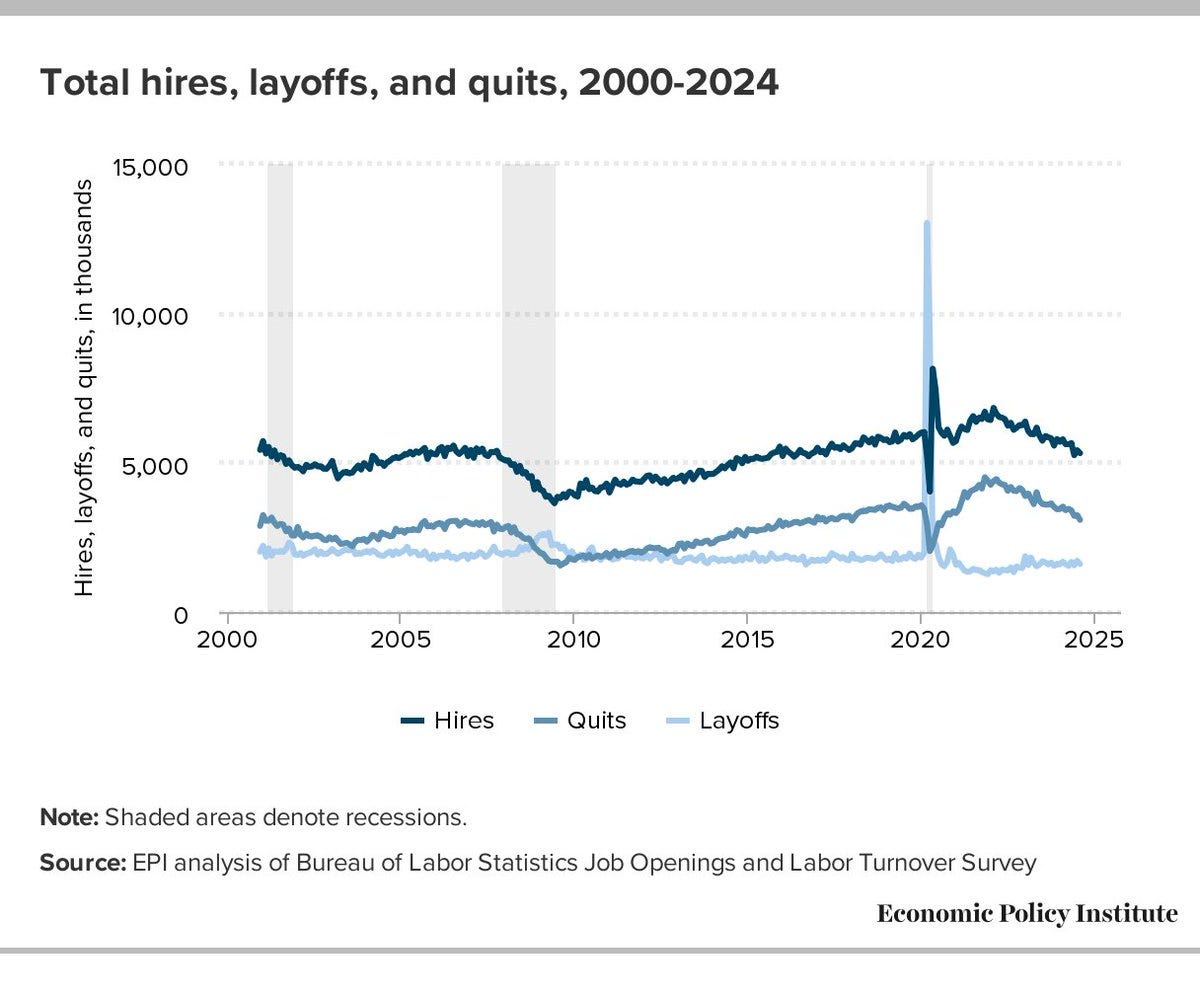
Results of JOLTS (Job Openings and Labor Turnover Survey) of the Economic Policy Institute (as of October 2024)
The pandemic, with its drastic countermeasures, the politically fueled and massively media-amplified fear, and, last but not least, the experience of illness or death, has prompted many to reflect on their own lives and career choices. Everyone has those moments at the major crossroads of one’s life. However, the pandemic hit the whole world simultaneously; thus, those individual moments of recollection manifest as a global trend.
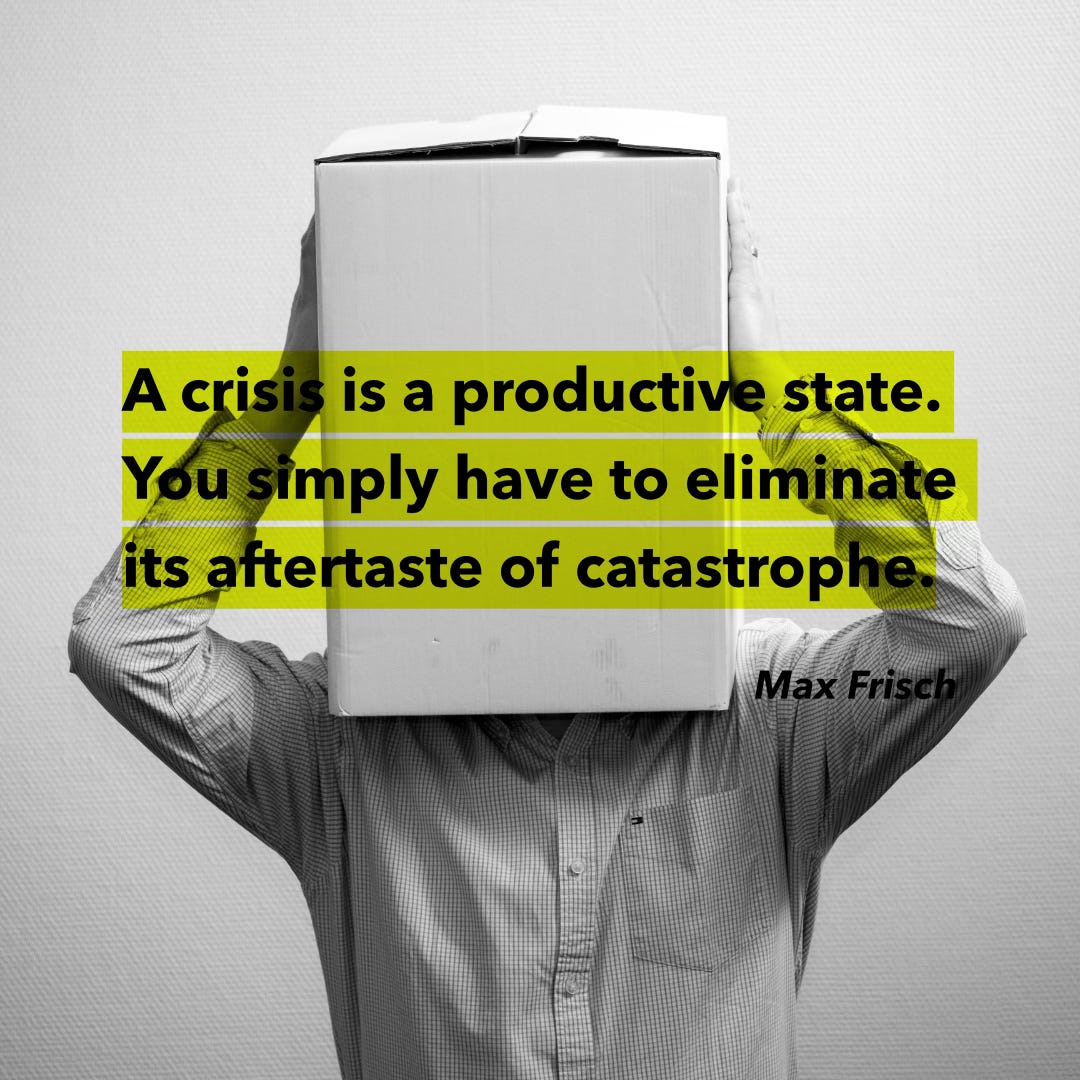
In addition to this psychological burden, working changed for most knowledge workers abruptly and fundamentally. And that was a revelation for many. Knowledge work was finally freed from time and space and became fully digital. One may quipingly conclude that digitalization has been driven much more by COVID-19 than by CDOs, CIOs, or CEOs in the last decade. “A crisis is a productive state. You simply have to eliminate its aftertaste of catastrophe”. This bon mot by Max Frisch also applies to this crisis. To contain the spread of the coronavirus, we were forced to learn distributed digital collaboration in virtual space at a previously unimaginable speed. The pandemic has triggered much reflection on the future of work, and at the same time, it forced us to find creative solutions.
This Manifesto for Humane Leadership was initially motivated by the question of how leadership must change in transitioning from a more traditional to a more agile organization. Ultimately, it is irrelevant where the impetus to rethink the role of management and turn to a more humane form of leadership comes from. Be it, as for Peter Drucker, the profound realization that knowledge workers need to be managed radically differently (see “Species Appropriate Keeping of Knowledge Workers”) or whether it is an agile transformation that raises this question of new leadership again. Or be it the pressure caused by the disruption of collaboration triggered by a global pandemic and what we have experienced and learned along the way.
For example, I have learned much about the value of time flexibility and autonomy. My wife and I have three children, and even with our two elder daughters, Marie and Ella, I have always tried to spend a lot of time with the family (parental leave, less traveling, reducing evening events, careful balancing of extra miles, etc.). Compared to our youngest, however, I didn’t get to see much of their early years: Valentin was born in January 2020, and I was in the home office a lot during his first three years. In addition, our eldest daughter started school in 2020, and I have always been able to help her with homework and homeschooling and give her moral support. I’ve also never been as fit as during this time because it was so easy to squeeze a short run somewhere into my schedule. This seamless integration of work and private life led to a better balance and less stress for me—and ultimately to better performance.
Unlike many others, I knew the value of autonomy and being fully in charge of my time already before the pandemic, as I had taken the unsatisfactory step from abundant time flexibility in our start-up to a classic presence culture with 8 hours or more in the office in the BMW Group IT (see Chapter 1). Our small consulting firm initially had no office at all and later only a small one where we met once a week as a management team. We were at the client’s premises or working from home most of the time. After all, a consultant needs to work with a customer instead of sitting in our office to earn money. That was common sense back then.
Part of my pain of adaptation when I moved to BMW in 2015 stemmed from the corporate world’s rigidity regarding where and when work is done. My pain was undoubtedly exacerbated by the fact that I would have liked to spend more time with my family after the birth of our first daughter in 2014.
The pandemic has shown many people how fulfilling it can be to integrate work and private life flexibly. This certainly has a local aspect because this “work-life integration” can only occur at the employee’s residence. However, local flexibility alone is of little use if constant availability is expected and the work is packed so tightly that it boils down to the tiring pattern of “eat, sleep, zoom, repeat” many of us experienced in the first year during the pandemic.
Remote work, therefore, is a misnomer. Its primary benefit is time flexibility rather than the ability to work from anywhere. We should remember that when imposing return-to-office orders, as so many companies have done now after the pandemic. The issue is not that people have to be physically in an office again but rather that being in the office at certain fixed hours reduces their ability to integrate life and work flexibly. That’s a deal breaker for many.
Leadership at a Distance
As we all have witnessed, the collaboration between knowledge workers can be moved into virtual space overnight. Unfortunately, leadership culture and managerial practices cannot be changed at the push of a button. The question often asked at the beginning of the pandemic, “How do I check whether my employees are doing their work from home?” is an unintended oath of disclosure of the manager. The micromanager had already been obsolete for quite a while, but he is finally bankrupt in the era of distributed collaboration.
As remote work became the new normal, trust issues became evident. The health crisis led to a confidence crisis. Remote leadership worked well for leaders who relied more on purpose and trust and less on command and control. Where this was not the case, many managers unintentionally revealed their questionable image of humanity while secretly hoping for an imminent return to the previous culture of presence.
The past years of enforced distributed working could also have been an opportunity to switch from input to impact. After all, the correlation of presence in the office with performance had never been very high. In knowledge work, the results count. When, how, and where those are achieved doesn’t matter. This realization has long existed in companies such as Basecamp13 or Red Hat14, which are primarily distributed and organized according to this principle of meritocracy. Some other organizations had this insight during the pandemic and switched entirely to remote15. However, most companies have miserably missed this unique opportunity.
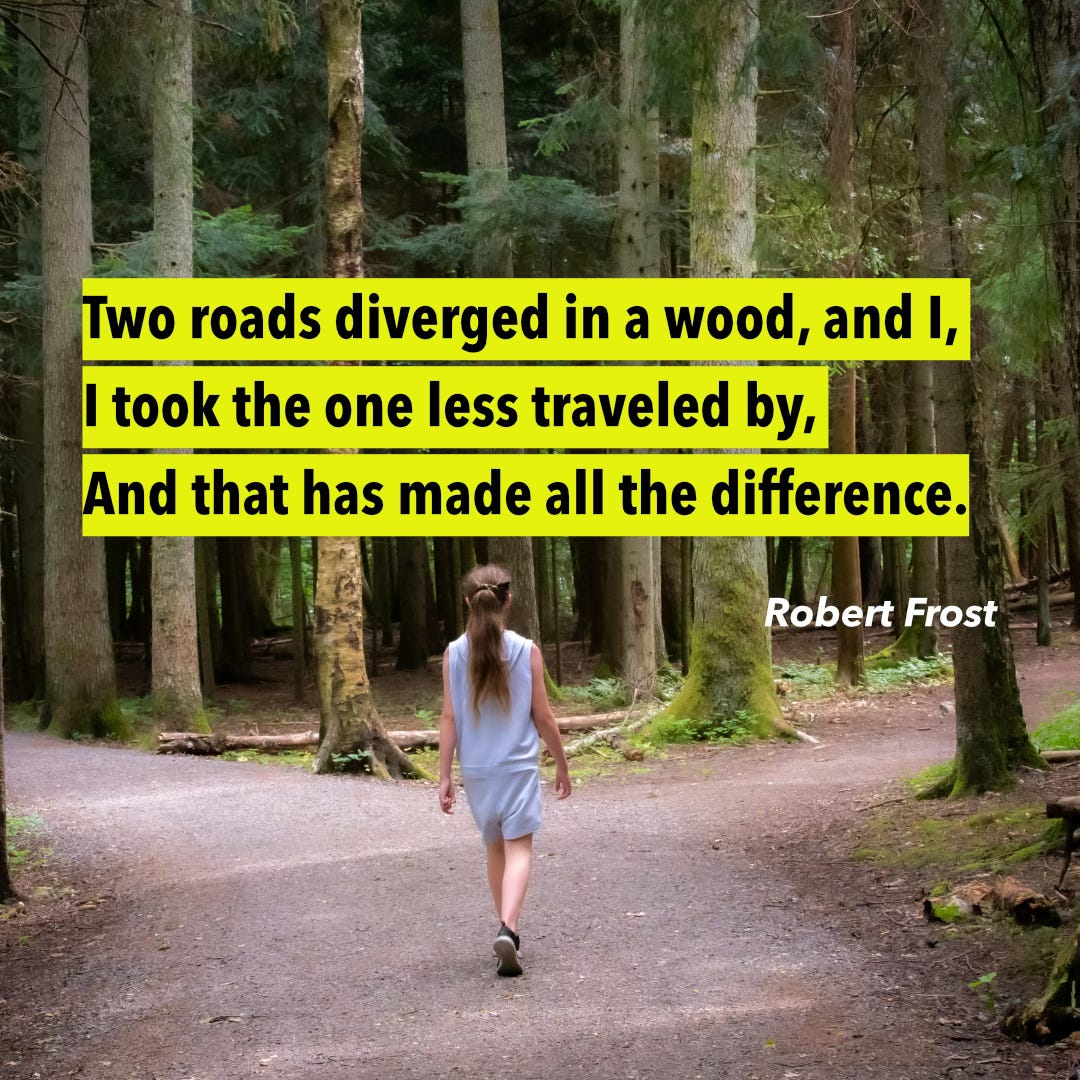
The famous poem “The Road Not Taken” by Robert Frost ends with these lines16: “Two roads diverged in a wood, and I, I took the one less traveled by, And that has made all the difference.” In the same way, managers and their organizations are faced with the choice between the overgrown path towards leadership based on meaning, trust, and self-organization on the one hand and the well-trodden path of classic hierarchical management with command and control on the other.
This choice has been there forever, but in this global crisis, it has become even more dramatic, and it no longer seems to be a decision between good and better but rather a question of whether to be or not to be.
-
Frederic Laloux and Ken Wilber, Reinventing Organizations: A Guide to Creating Organizations Inspired by the Next Stage of Human Consciousness (Nelson Parker, 2014). ↩
-
Götz W. Werner, Womit ich nie gerechnet habe: die Autobiographie, 5. Auflage, List-Taschenbuch 61254 (Berlin: List Taschenbuch, 2019). ↩
-
Karlheinz A. Geißler, Alles hat seine Zeit, nur ich hab keine Wege in eine neue Zeitkultur (München: Oekom Verlag, 2014), 232. ↩
-
Werner, Womit ich nie gerechnet habe, 173. ↩
-
Kent Beck et al., “Manifesto for Agile Software Development,” 2001, https://agilemanifesto.org/ ↩
-
Douglas McGregor and Joel Cutcher-Gershenfeld, The Human Side of Enterprise, Annotated ed (New York: McGraw-Hill, 2006). ↩
-
Peter F. Drucker, Landmarks of Tomorrow, Harper Colophon Books (Harper, 1959). ↩
-
McGregor and Cutcher-Gershenfeld, The Human Side of Enterprise. ↩
-
Peter F. Drucker and Joseph A. Maciariello, Management, Rev. ed (New York, NY: Collins, 2008), 72. ↩
-
Drucker and Maciariello, 72. ↩
-
Arianne Cohen, “How to Quit Your Job in the Great Post-Pandemic Resignation Boom,” Bloomberg Businessweek, May 10, 2021, https://www.bloomberg.com/news/articles/2021-05-10/quit-your-job-how-to-resign-after-covid-pandemic. ↩
-
“JOLTS,” Economic Policy Institute, accessed October 3, 2024, https://www.epi.org/indicators/jolts/. ↩
-
Jason Fried, David Heinemeier Hansson, and David Heinemeier Hansson, ReWork: Change the Way You Work Forever (London: Vermilion, 2010). ↩
-
Jim Whitehurst, The Open Organization: Igniting Passion and Performance (Boston, Massachusetts: Harvard Business Review Press, 2015). ↩
-
Kathryn Vasel, “These Companies Decided to Go Fully Remote – Permanently | CNN Business,” CNN, January 27, 2022, https://www.cnn.com/2022/01/27/success/full-time-remote-decision-pandemic/index.html. ↩
-
Robert Frost, “A Group of Poems,” The Atlantic, August 1, 1915, https://www.theatlantic.com/magazine/archive/1915/08/a-group-of-poems/306620/. ↩