Pain of Adaptation
Love it
In mid-2010, I became a Senior Partner at esc Solutions, a newly founded IT project management start-up that worked anywhere between classic and agile. There were three of us, full of drive and idealism. We didn’t yet know what we stood for or what we would offer beyond our own time and labor, but we knew we wanted to work differently from how we had worked in IT consulting. What united us was less a grand vision than the “away from” and the “completely different.” At least that’s how I felt.
At first we had no office, and our only guideline was common sense. Essentially, we followed Herb Kelleher’s motto: “We have a strategic plan. It’s called doing things.” We had a lot of fun doing it. In 2010 I started a regular blog to position the company. It connected me with many like-minded rebels and, luckily, brought us new customers.
The company grew, and with each new person the question of our identity became more pressing. Why would someone work for us rather than elsewhere, or as a freelancer? What defines us at our core and sets us apart? After many intensive discussions, the management team realized that we held fundamentally different views. I still firmly believe that profit cannot and should not be the purpose of an organization. There must be a deeper “why”: the reason we get up on Monday morning and do what we do at this particular company.
Leave it
Then one thing led to another, and I was (once again) offered an attractive position at BMW Group IT, where I had worked on various projects for ten years.
I took the path many consultants had taken before me and moved to the customer side. I went from one extreme to the other: maximum freedom (and, frankly, sometimes chaos) gave way to maximum regulation. At least that’s how it felt at the time. I quickly reached the limits of my ambition to change things for the better. When I invited several project managers from agile projects to a community of practice, which seemed the most natural thing to do, the first question was whether I was entitled to do so and who had given me permission.
Everything was perfectly organized.
I wasn’t used to that, and I was bothered by things others no longer noticed. I understood the need for health and safety instructions, but I hadn’t earned a doctorate, built a house, and started a family only to be admonished like a child to use the handrail on the stairs. The opposite of good is good intentions.
I felt overprotected.
I looked for the reason for my dissatisfaction in myself, because on the surface most of the others seemed quite happy. The cage was warm and comfortable, and there was enough to eat—but it was too tight for me. The company and I simply didn’t fit together, and I was convinced that fighting for change would be presumptuous. I didn’t want to be Don Quixote.
Of the three known solutions—”Love it, leave it, change it”—only leaving seemed open to me. I had some interesting interviews, but none led anywhere. Fortunately, as I recognized later: another move away from a problem would have kept me from seeing the inspiring journey waiting behind it. Or, as Marcus Aurelius said:1 “The impediment to action advances action. What stands in the way becomes the way.”
Change it
Back then, I was keen on social media and soon discovered BMW’s internal Enterprise Social Network. It disappointed me too: it merely replicated the silos of the organization, had few open groups, and hosted hardly any relevant discussion. But it made me understand why Working Out Loud (WOL)2 mattered in big corporations. I had underestimated the concept because I took it for granted that ideas could be shared and discussed openly.
I started taking part in the few open groups, questioning things critically and starting discussions about becoming a more agile and modern organization. Gradually I met many like-minded people inside the company, people who wanted, as I did, to change how we worked and to make the corporate culture fit for the future, such as the many in the Connected Culture Club and the WOL movement.
The dedication of so many people in these grassroots movements inspired me and gave me renewed hope. Perhaps striving for change wasn’t presumptuous or utopian after all. Even more hopeful, many of these movements had the support of top management, who used their energy and commitment to drive change instead of suppressing it. I still didn’t want to be Don Quixote, but I increasingly saw the value of civil disobedience, of cultivated rebelliousness, and of my chosen role as corporate jester: change requires disturbance.
Agility gained importance in BMW Group IT and in 2017 became the grand “100% Agile” strategy. Instead of a few more or less agile projects here and there, we rebuilt IT as a fully agile product organization that delivers new features continuously, rather than treating change as an exception for a project to handle.
And I was right in the middle of it! By then I had gained great visibility within the company, especially for agility (thanks to WOL and to managers who encouraged me and could handle rebellious minds like mine), and beyond it (thanks to my blog, which I kept writing more or less weekly after joining BMW). As an Agile Transformation Agent, I passionately gave the elephant many dancing lessons over several years. I am proud of the lasting impact: BMW Group IT is still organized and run by the principles and guidelines we designed then.
We had to consider many aspects of this large-scale transformation. At the beginning of 2018, we investigated how leadership changes in an agile organization. In a workshop with representatives from every layer of the hierarchy, from regular employees to the vice president, we spent three hours on what leaders expect of their self-organizing teams and what those teams need from their leaders. We ended up with several large brown papers full of ideas. In a quick chat afterwards, a colleague suggested distilling the insights into leadership principles for an agile organization, like those of the Manifesto for Agile Software Development.
I happily accepted the challenge and developed the six theses at the core of the Manifesto for Humane Leadership one by one, first on Twitter and LinkedIn, then summarized in a blog post. After many people had signed the original Manifesto on my blog, I added thoughts and content and self-published everything via Amazon, first in German3 and then in English4.
I also had the honor of promoting agility and our transformation in many presentations and workshops, inside and outside the company. As my interest shifted toward agile leadership, my talks stressed that an agile transformation requires a transformation of the leadership role.
I still count the transformation period from 2017 to 2019 among the most fulfilling of my professional life.
Everything is in flux, “panta rhei,” wrote Heraclitus. And this high was followed by another low. After several new appointments in BMW’s upper management, agility was still in demand, but no longer as a steadily progressing transformation. BMW Group IT’s agile transformation entered a phase of consolidation, operationalization, and industrialization. The time of pioneering was over. In the terms of Simon Wardley’s apt model,5 the company no longer needed pioneers but settlers and town planners. I am a passionate pioneer, so I had to be consistent and find a new professional home where I could use this expertise and passion again.
After a brief detour into the semiconductor industry, my path led me to Allianz Consulting, Allianz’s in-house consulting unit, where I now have the honor of leading a multinational team of agile coaches. I took the topic of agile transformation with me through these moves, and in particular the necessary transformation of the leadership role, which is the focus of this book.
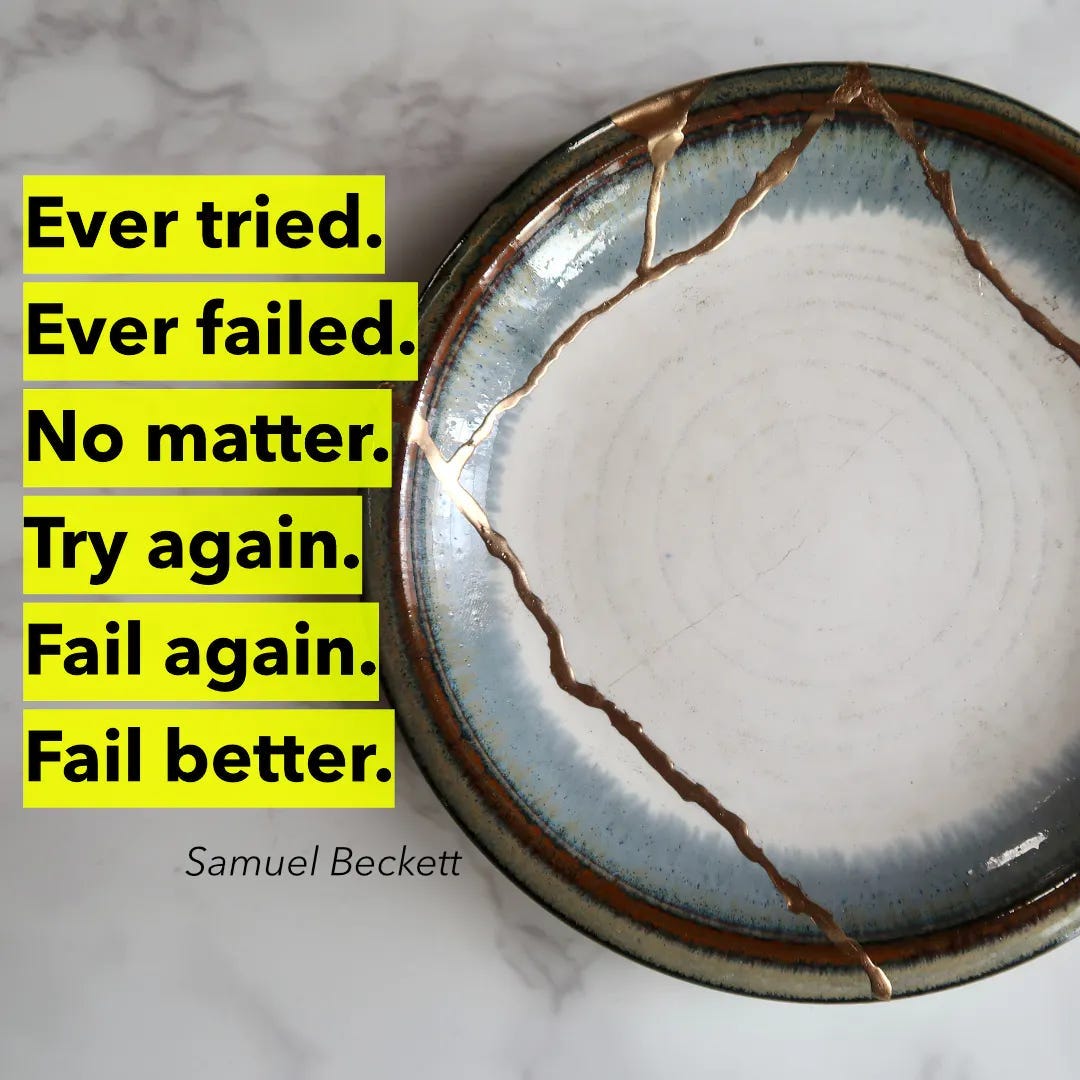
What felt like a pile of broken pieces at the time formed, in retrospect, a unique and exciting picture. The obstacle became the way. It is like Kintsugi, the traditional Japanese method of repairing broken ceramics with lacquer mixed with gold, silver, or platinum powder. Instead of concealing the fractures, it highlights them. The flaw becomes part of the object’s history, and its beauty shows in that imperfection. In the same way, my failures are an essential part of me, and I don’t have to hide them.
-
M. Aurelius and G. Hays, Meditations: A New Translation (Random House Publishing Group, 2002), 60. ↩
-
John C. Stepper, Working out loud: a 12-week method to build new connections, a better career, and a more fulfilling life (Vancouver, British Columbia: Page Two Books, 2020). ↩
-
Marcus Raitner, Manifest für menschliche Führung: Sechs Thesen für neue Führung im Zeitalter der Digitalisierung (Independently Published, 2019). ↩
-
Marcus Raitner, Manifesto for Human(e) Leadership: Six Theses for New Leadership in the Age of Digitalization (Amazon Digital Services LLC - KDP Print US, 2020). ↩
-
Simon Wardley, “On Being Lost,” Wardleymaps (blog), August 27, 2017, https://medium.com/wardleymaps/on-being-lost-2ef5f05eb1ec ↩