Six Theses for New Leadership
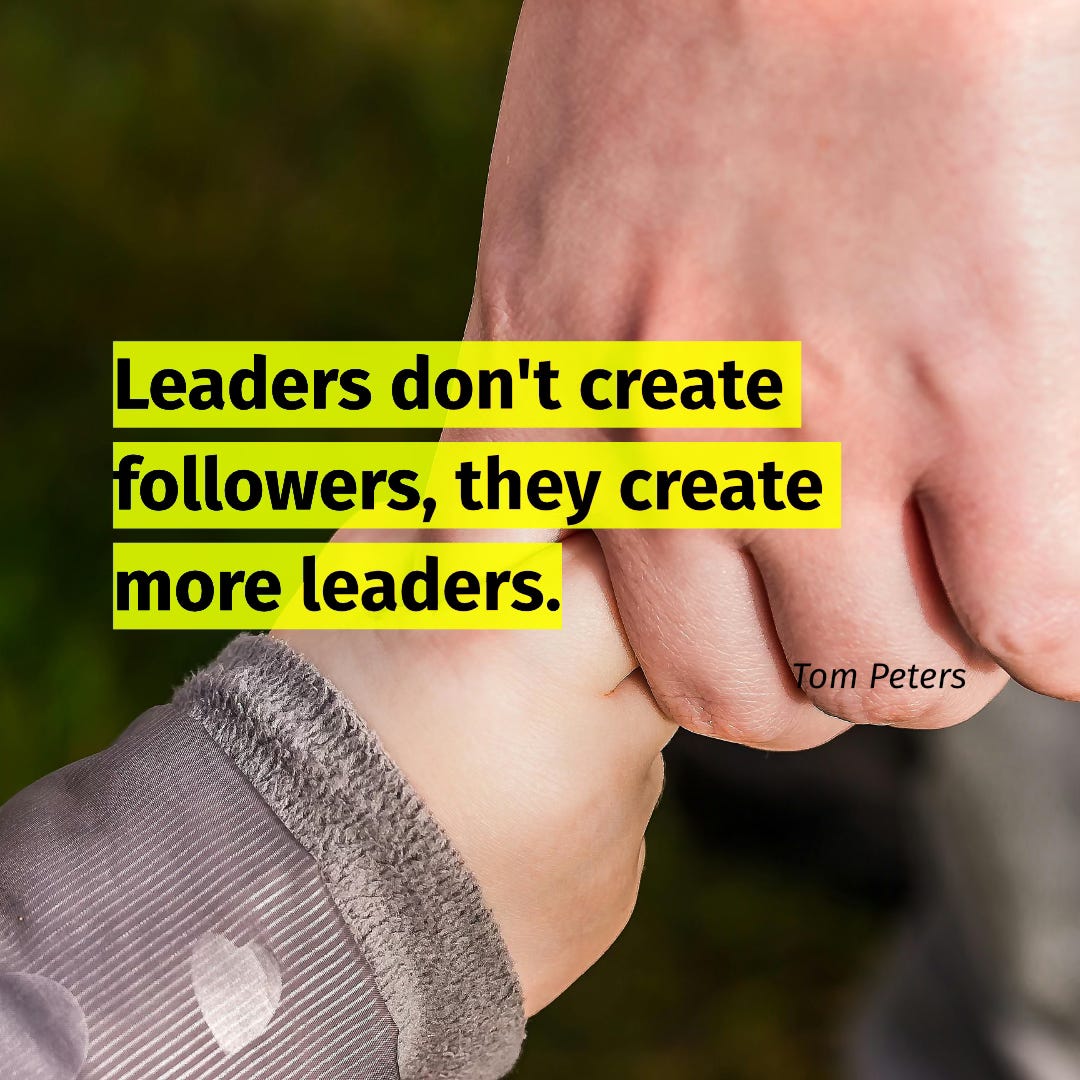
Leaders don’t create followers; they create more leaders.
Tom Peters
Why new leadership? And why now? New leadership is not a new phenomenon—reevaluating leadership has been necessary and overdue for some time. However, it is becoming urgent due to digitalization and increasingly distributed working, intensified by the recent coronavirus pandemic (see Section “The Coronavirus Pandemic as New Work Boost?”).
The relationship between employees and their organization changed fundamentally from the industrial age to the age of knowledge work. Dependent workers have become increasingly independent knowledge workers who carry their means of production in their heads. The organization is, therefore, more dependent on these knowledge workers than vice versa (see Section “Species-Appropriate Keeping of Knowledge Workers”). This transition took time; it was a long and steady process that is still ongoing. Although Peter Drucker pointed out this development as early as 1959, he still needs to receive sufficient attention. Despite the theoretical insight, most organizations in the 21st Century still follow the machine model of the fading industrial age.1
For too long, leadership has aimed at obedience. Children were (and unfortunately still are today) brought up at home and school to fit into society and its (outdated) organizational patterns. And this integration meant and still means subordination at its core. Although the impermeable feudal system of the Middle Ages is a thing of the past, the organizational principle of hierarchy stood the test of time precisely because the Enlightenment created the possibility of personal advancement: no hierarchical order–no advancement. In the course of industrialization with its large corporate structures, this principle, therefore, was expanded and differentiated considerably.
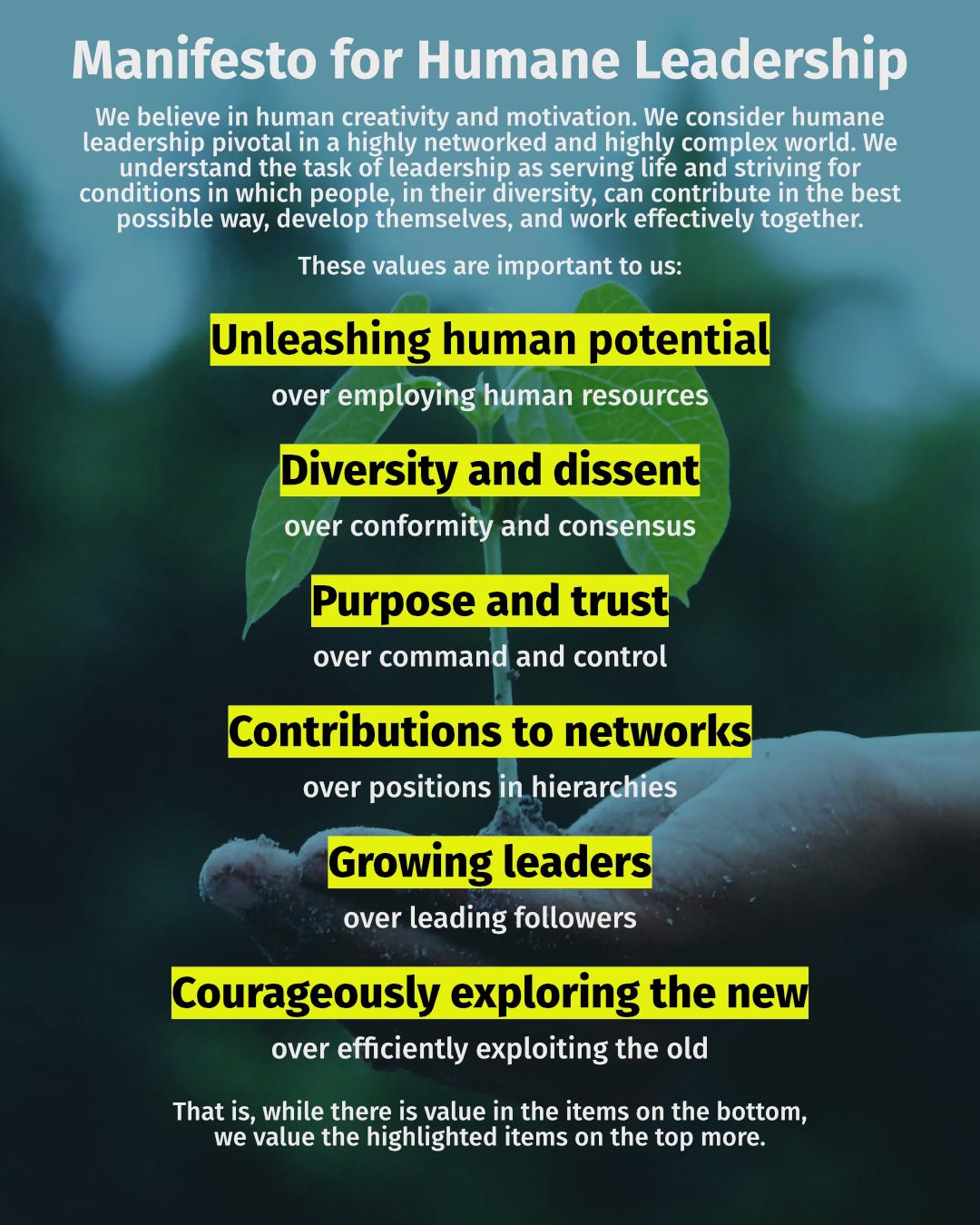
It is high time to make leadership more human and more humane. This “Manifesto for Humane Leadership” is meant to be an impetus and guide for that endeavor. The well-known “Manifesto for Agile Software Development”2 served as a template. On the one hand, the question of new leadership, which I tried to answer with this Manifesto, arose during the agile transformation of BMW Group IT. On the other hand, the format of the theses is connectable and builds bridges instead of demonizing the previous principles and glorifying the new.
Human Potential, Not Human Resources
Anyone who views organizations as machines and treats people like cogs cannot complain that employees are working to rule. Under these circumstances, functioning as flawlessly as possible is the most we can expect. The “Gallup Engagement Index,” which Gallup has used since 2000 to measure employee engagement worldwide, clearly shows the full extent of this wastefulness. The results are sobering year after year: In Germany, for instance, around 15 percent are actively disengaged, and around 70 percent are not engaged, i.e., they more or less work by the book. The values vary from country to country, but most employees are disengaged.3
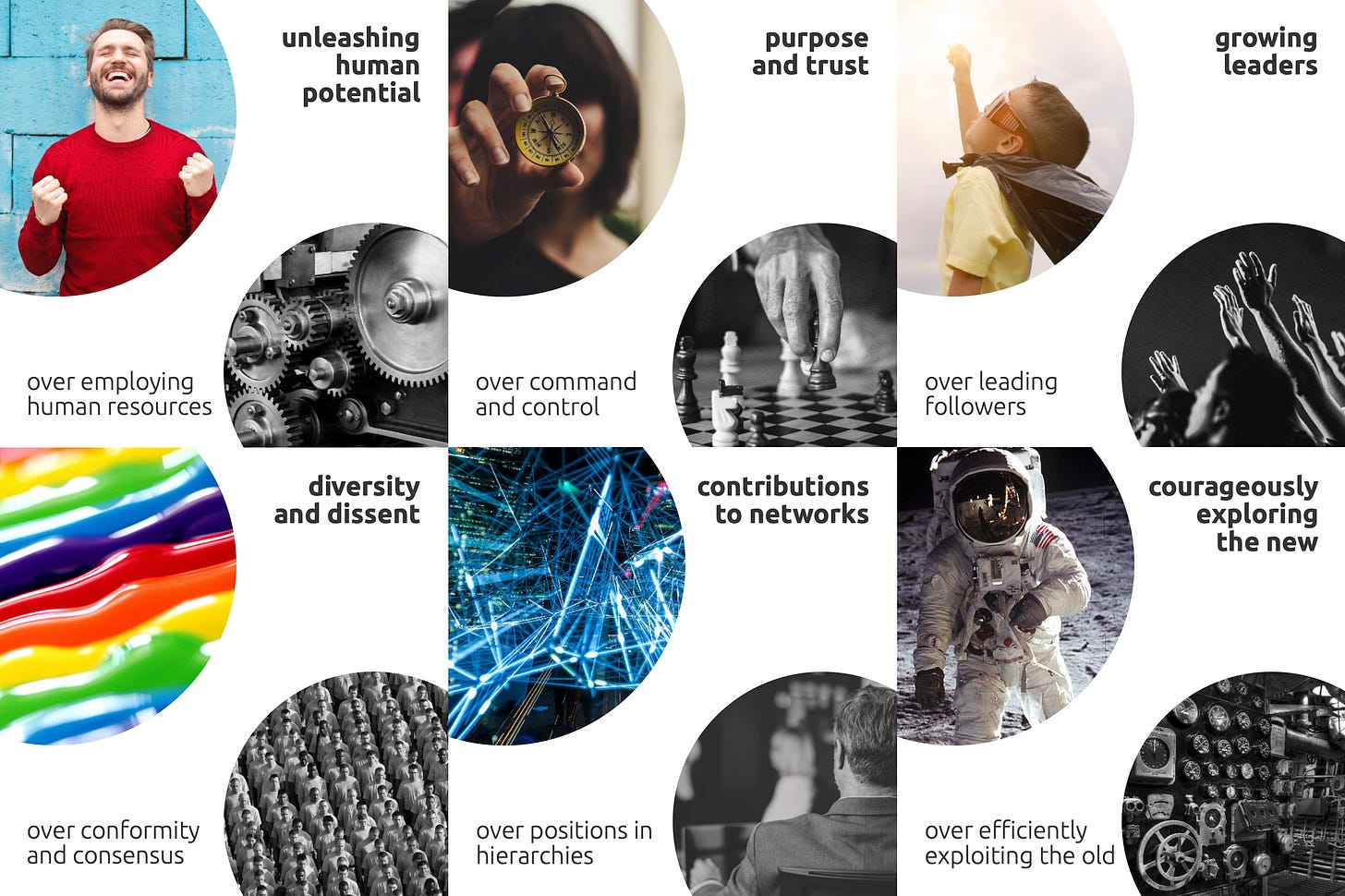
However, the employees are not to blame here, or at least not predominantly. Where organizations and management treat people as resources, they behave as such. The same people are motivated and creative and often develop their potential in their free time—or fall short of their full potential (see Section “The Eight Type of Waste”). Leadership can make a decisive difference here for all sides. That is why the first thesis of the Manifesto for Humane Leadership is: “Unleashing human potential over employing human resources.”
Of course, organizations are also about human labor. Using physical and mental capacities effectively and efficiently is essential. That is why at the very end of the Manifesto for Humane Leadership, there is the statement: “That is, while there is value in the items on the bottom, we value the highlighted items on the top more.” It reminds us not to forget or underestimate the fact that this professional management of labor in the 20th Century led to an enormous increase in productivity in manual activities, as Peter Drucker summarizes:4
The most important, and indeed the truly unique, contribution of management in the 20th Century was the fifty-fold increase in the productivity of the manual worker in manufacturing. […] The most important contribution of management in the 21st Century will be to increase knowledge worker productivity—hopefully by the same percentage. […] The methods, however, are totally different from those that increased the productivity of manual workers.
Today, it is no longer sufficient to merely manage the human workforce. Both people and activities have changed massively over the past 50 years. Manual work has been and continues to be increasingly automated. As a result, the proportion of knowledge work is constantly increasing. And people are no longer unskilled or low-skilled workers, as in the days of Frederick Winslow Taylor, but more and more well-trained knowledge workers. Still, using their labor, capacity, and creativity is crucial, but the only ones who can and should decide on this are the knowledge workers themselves, as Peter Drucker put it:5
Even if employed full-time by the organization, fewer and fewer people are “subordinates”—even in fairly low-level jobs. Increasingly they are “knowledge workers.” And knowledge workers are not subordinates; they are “associates.” For, once beyond the apprentice stage, knowledge workers must know more about their job than their boss does—or else they are no good at all. In fact, that they know more about their job than anybody else in the organization is part of the definition of knowledge workers.
In the era of knowledge work, self-organization is taking the place of management more and more. The appropriate leadership motto now is “enabling self-leadership” (see Section “Enabling Self-Leadership”). The task of leadership is no longer to employ standardized “human material” as profitably as possible but instead to act like a gardener. The task is to create and maintain an environment in which people can develop their full potential and use as much of it for the organization. “Leadership is a service—not a privilege. The service for employees is to offer them the opportunity to develop themselves.”6 At Upstalsboom, this motto of Bodo Janssen has led to resounding success in terms of employee satisfaction (up 80 percent) and sickness rate (from eight percent to less than three percent), but also in terms of revenue (doubling within three years) while at the same time increasing productivity.7
Creating value through valuing people instead of exploiting human resources is the future.
Diversity and Dissent
Diversity originated in the civil rights movement in the USA. Since then, it has been a much-noticed and controversial topic in organizations and society. It generally refers to the equal participation of people of different origins, genders, religions, or ages. In this respect, diversity usually means equal opportunities or, at least, the absence of discrimination. While this is desirable and self-evident, it only touches the surface.
Diversity in age, gender, origin, etc., is useless if the organizational culture leans toward conformity and consensus. The leaders in such a culture will likely fall into the same grid regardless of gender because the culture and assessment systems can only produce one type of manager, irrespective of gender or other markers of diversity.
We seek a culture in which the different perspectives of people—how they think and solve problems based on their unique experiences and their values—are highly valued. This diversity of thinking is the antidote to dangerous groupthink. Having a diverse workforce is necessary for such a culture, but it is not sufficient. The decisive factor is what the culture does with the heterogeneity the people bring to work: Standardize or nurture?
The second thesis of this Manifesto for Humane Leadership, “Diversity and dissent over conformity and consensus,” means striving for a supportive and inclusive culture that values individuality more than conformity and sees constructive dissent as a necessary part of good decision-making processes. In the words of Dwight D. Eisenhower:8 “May we never confuse honest dissent with disloyal subversion.”
Peter Drucker also advises in his book “The Effective Executive”9 that no decision should be made without really discussing the issue. As a prime example, he cites Alfred P. Sloan, who reportedly said in a meeting of a top committee: “Gentlemen, I take it we are all in complete agreement on the decision here.” Everyone around the table nodded assent. “Then,” continued Mr. Sloan, “I propose we postpone further discussion of this matter until our next meeting to give ourselves time to develop disagreement and perhaps gain some understanding of what the decision is all about.”
Kim Scott reports something similar in her book “Radical Candor” about Steve Jobs10. A colleague of Steve once gave way in a dispute with Steve, although Steve’s arguments did not convince him. In retrospect, it turned out that Steve was wrong, and the colleague was right. Instead of apologizing, Steve ran into his colleague’s office and scolded him loudly. “But it was your idea,” the colleague tried to justify himself. Steve replied: “Yes, and it was your job to convince me that I was wrong. And you failed.”
Leading with Purpose and Trust
The most fundamental task of leadership is to ensure a common direction. With that in mind, leadership is particularly crucial for agile organizations. Agility requires alignment to make self-organizing teams effective. If this orientation is missing, agility becomes arbitrary, and, in the worst case, you end up running around in circles.
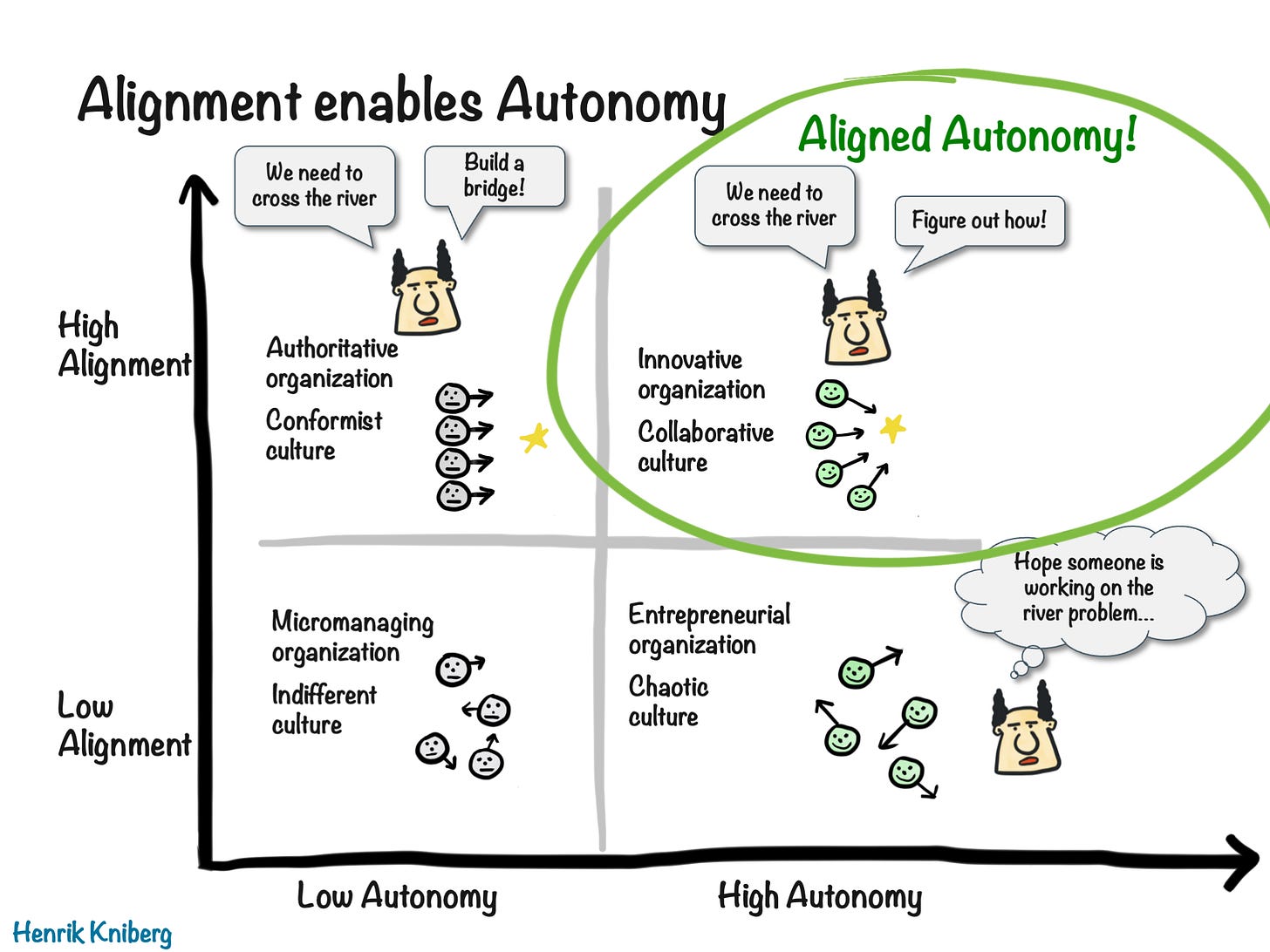
The tension between alignment and autonomy, according to Henrik Kniberg
Self-organizing teams are a core element of agility. The remarkable flexibility and customer focus of agile organizations result from the speed of decentralized decision-making. As Henrik Kniberg shows in the above illustration, autonomy requires alignment so everyone knows and works towards the common goal.
Therefore, the question is not whether but how leadership should provide orientation today. On the one hand, there is the more traditional top-down management approach through policies and detailed instructions. On the other hand, leadership can also guide by fostering a shared vision and a joint mission and trusting in the inherently motivated individuals willing to make the best possible contribution. That is meant with “Purpose and trust over command and control,” the third thesis of the Manifesto for Humane Leadership.
A key characteristic of knowledge work is that knowledge workers are no longer unskilled and require a skillful manager to make their workforce productive, as was the case at the time of Frederick Winslow Taylor. They own their means of production regarding their knowledge, experience, and skills. Consequently, knowledge workers must be led at eye level (see Section “Species-Appropriate Keeping of Knowledge Workers”).
Self-organizing, agile teams are only a special case of the more general question of how to manage knowledge workers. Peter Drucker’s answer is relatively simple: knowledge workers must be managed as if they were volunteers otherwise financially secure. With that, leading with pressure and fear is no longer viable. The only option is to offer a purpose and a vision to which as many people as possible want to contribute voluntarily because they are attracted to it.
In this sense, the Manifesto for Humane Leadership’s third thesis emphasizes purpose and trust over command and control. Yet, the theses are meant to give a direction, and at the very end of the Manifesto, it is stated that both sides of the theses are important. But after the considerations just made, do command and control still have a raison d’être today? Shouldn’t it read: “Purpose and trust instead of command and control”?
A boss who moves the pawns across the field like a chess master without giving any further context should hopefully be encountered less and less today. On the other end of the spectrum, fully purpose-driven, visionary leadership and a mature culture of trust, in which everyone does their best to make the vision a reality, is more an aspirational ideal than the reality. In practice, there will be all sorts of graduations between those book ends; thus, there is still some need for command and control. But that should not serve as an excuse not to try hard to avoid it and to come even closer to the ideal.
Network and Hierarchy
Hierarchy has advantages when organizing a well-known business model as efficiently as possible according to defined processes and roles. However, more is needed to achieve long-term and sustainable success. In addition to this hierarchy, designed for the stability and efficiency of today’s business, there also needs to be a component responsible for change, improvement, the new, and ultimately, the business of tomorrow.
Traditionally, this task falls to strategy departments, and their means of choice are dedicated change programs and task forces. These approaches have in common that those changes become temporary parts of the hierarchy, and familiar management methods are used to steer them. Those traditional change management methods work well for changes with clear objectives, e.g., introducing a new CRM system or remuneration model. Yet, the basic assumption here is that change is the exception rather than the rule, and strategic decisions are the task of a few strategists and top management.
However, in a world becoming increasingly volatile and markets becoming ever faster, thus making change constant, these traditional centralized change processes fail due to their inherent sluggishness. In such a fast-paced environment, change must become the second nature of the organization, the second operating system, as John Kotter states:11
We cannot ignore the daily demands of running a company, which traditional hierarchies and managerial processes can still do very well. What they do not do well is identify the most important hazards and opportunities early enough, formulate creative strategic initiatives nimbly enough, and implement them fast enough.
The network complements the hierarchy as the first and dominant operating system. The basic idea of this network is to recruit an army of volunteers from all over the hierarchy. They work continuously on change and improvement in small, loosely linked initiatives. They share a strong sense of purpose, a common understanding of the need for change, and a strong sense of urgency. New initiatives and directions will emerge faster within this loose strategic alignment framework, and opportunities will be exploited more quickly.12
Traditional managers of the first operating system, the hierarchy, have an essential role to play. In addition to their primary job as managers of day-to-day business, they must ensure that the network thrives and that the people’s contributions to it are equally valued. Leadership in this network is based on purpose and trust rather than command and control (see previous section). The activities in the network require a strong shared sense of purpose and a shared vision to which people can wholeheartedly say yes and to which they happily contribute their time and labor. However, for people to engage in this network alongside their work in the hierarchy, they need permission and the freedom to work on change and improvement. It does not have to be the well-known 20 percent rule at Google, but leadership has to frame explicitly the expectation and the boundary conditions. The key ingredient, however, is trust. Without hierarchical power, only trust can hold this network together and make collaboration productive and effective.
This second operating system, the network, is a meritocracy, as we know it in open-source software development, from Wikipedia and companies such as RedHat13. The task of leadership is to balance both operating systems, the hierarchy and the network. Coming from the first and established operating system of hierarchy, this means strengthening the already existing more or less informal networks in the organization through permission, freedom, trust, and patience. That is why the fourth thesis in the Manifesto for Humane Leadership is “Contributions to networks over positions in hierarchies.”
Encounter at Eye Level
Leadership is a question of attitude. Unfortunately, leadership is still defined in terms of rank, power, and subordination. The relationship between the leader and their people is usually asymmetrical: the boss has more experience, information, and power than his employees, who are, therefore, more dependent on their boss than the boss is on them.
Historically, this attitude stems from Taylorism, where the manager was, in fact, the one who understood the work processes best and was able to break them down into tiny work steps for the then mostly unskilled workforce. However, those days are long gone. The nature of the work and employees’ expertise has changed radically since then. Unfortunately, in many cases, the only thing that hasn’t changed is the dependency between boss and employee.
Peter Drucker coined the term knowledge work back in 1959 (well ahead of his time). Since then, he has repeatedly addressed the fundamental differences between knowledge work and the manual work of Taylorism. He reframed leadership as a professional collaboration between adult experts on eye level. The relationship between managers and knowledge workers is more akin to that between a conductor and the instrumentalists in an orchestra. The position of knowledge workers to their manager is entirely different from that of the arbitrarily interchangeable worker to his boss in Taylorist structures. A knowledge worker can sabotage his superior just as easily and effectively as an instrumentalist can sabotage an autocratic conductor (see Section “Species-Appropriate Keeping of Knowledge Workers”).
Even sixty years after Peter Drucker invented knowledge work, we are unfortunately still in the early stages of implementing it. Of course, the relationship between managers and employees has changed significantly for the better in recent decades, and many managers have now adopted a more parental and supportive attitude toward the people entrusted to them. The direction is correct, but the traditional dependency has mostly remained unchanged. And while children demand their independence more or less vehemently at various stages of their development, employees today remain well-protected children throughout their whole career.
Leadership is only legitimate if it aims at the self-management of the employees entrusted to it.14 Götz Werner has thus summed up what a contemporary relationship between leaders and their people looks like. It is not about being superior or subordinate but an encounter at eye level.
Leadership is an equally important function; its task is to make others successful. That is why the fifth thesis of the Manifesto for Humane Leadership is: “Growing leaders over leading followers.” Leading dependent employees is one thing and is still an important skill. The other, and much more crucial, is the attitude to lead employees out of this dependency and turn them into leaders. “Leaders don’t create followers, they create more leaders.”, as Tom Peters puts it in a nutshell.15
The Art of Ambidexterity
We are experiencing a world in which it is “normal that many things have become different and are becoming more different faster and faster,” as Karlheinz A. Geißler aptly put it.16 Life’s perceived speed is increasing daily, driven by fascinating and sometimes frightening technological developments such as artificial intelligence or blockchain. These advancements enormously increase the pressure for change and innovation in companies. The half-life of products and business models is getting shorter and shorter.
In plain language, this means that companies have to reinvent themselves again and again and at ever shorter intervals to survive. In addition to focusing on efficiency and profitability in today’s business, it must become second nature for companies to boldly explore new opportunities and constantly try out new business models. However, because today’s urgent business tends to crowd out what is vital in the long term, namely the ideas for tomorrow’s business, the sixth and final thesis in the Manifesto for Humane Leadership is: “Courageously exploring the new over efficiently exploiting the old.”
Building a company around one product or product family with one single profitable business model and scaling this business is a considerable achievement. That’s why most companies don’t even make it through this start-up phase. The few who succeed have all hands full operating their business.
For some companies, things go exceptionally well, such as Xerox with photocopiers, Kodak with films, or IBM with mainframe computers. What happens in this phase of incredible success is described excellently by Steve Jobs17: While in the initial phase, the company is led and driven by the products and the passion for great products, marketing and sales gradually take over the helm. On the one hand, fully exploiting existing products and business models makes sense. On the other hand, it also carries the seeds of decline because the focus shifts from new and innovative products and business models to the profit of the current business.
To solve this problem, companies set up research laboratories or research departments. At Xerox, for example, this was the well-known Xerox Palo Alto Research Center (PARC). The list of inventions from Xerox PARC is impressive: “Xerox PARC has been foundational to numerous revolutionary computer developments, including laser printing, Ethernet, the modern personal computer, GUI (graphical user interface) and desktop paradigm, object-oriented programming, ubiquitous computing, electronic paper, a-Si (amorphous silicon) applications, the computer mouse, and VLSI (very-large-scale integration) for semiconductors.”18 Being located on the West Coast with a distance of 3,000 miles to the headquarters in Rochester, New York, gave the scientists great freedom to work on exciting things. However, it also disconnected them from management. Xerox failed to bring most of those inventions to market successfully.
For true organizational ambidexterity, i.e., the ability to exploit the existing and explore the new simultaneously, it is not enough to place the two side by side. Xerox was very successful in the copier business model of the time, and Xerox PARC was highly innovative. The problem was transferring the ideas into new products and business models. Xerox was so fixated on its well-known copier business that many of Xerox PARC’s groundbreaking innovations were too far away. Conversely, Xerox PARC was fixated on technology and innovation and paid little attention to translating them into business models and integrating them into Xerox.
This ambidexterity works better for Amazon, for example. Initially, Jeff Bezos expanded the online bookseller’s product range in an obvious way to create a complete online department store. But then came new business models. Amazon became a marketplace, a logistics service provider, a leading cloud service provider with AWS, a hardware manufacturer, and much more.
Despite its size and core operating business, it is essential for Amazon’s long-term success in a competitive and fast-moving industry to always think and act like a start-up and to constantly experiment with new business models and services, sometimes with considerable investments at stake. Striking the right balance and seamlessly integrating the optimization of the existing business model on the one hand and the invention of new business models on the other is undoubtedly a challenging but crucial leadership task in the VUCA world.
-
Frédéric Laloux and Ken Wilber, Reinventing Organizations: A Guide to Creating Organizations Inspired by the next Stage of Human Consciousness, First edition (Brussels: Nelson Parker, 2014). ↩
-
Kent Beck et al., “Manifesto for Agile Software Development,” 2001, https://agilemanifesto.org/. ↩
-
“Indicator: Employee Engagement,” Gallup.com, accessed October 8, 2024, https://www.gallup.com/394373/indicator-employee-engagement.aspx. ↩
-
Peter F. Drucker and Joseph A. Maciariello, Management, Rev. ed (New York, NY: Collins, 2008), 191. ↩
-
Drucker and Maciariello, 71. ↩
-
Bodo Janssen, Die stille Revolution: Führen mit Sinn und Menschlichkeit, 7. Auflage (München: Ariston, 2016), 48. ↩
-
Janssen, 274 f. ↩
-
United States Department of State Office of Media Services and United States Department of State Office of Public Communication, The Department of State Bulletin, Bd. 30 (Office of Public Communication, Bureau of Public Affairs, 1954), 901. ↩
-
Peter F. Drucker, The Effective Executive: The Definitive Guide to Getting the Right Things Done, repr. (New York, NY: Harper, 1967), 148. ↩
-
Kim Scott, Radical Candor: Be a Kick-Ass Boss without Losing Your Humanity, Fully revised & updated edition (New York: St. Martin’s Press, 2019), 80. ↩
-
John P. Kotter, “Accelerate!,” Harvard Business Review, November 1, 2012, https://hbr.org/2012/11/accelerate. ↩
-
Kotter. ↩
-
Jim Whitehurst, The Open Organization: Igniting Passion and Performance (Boston, Massachusetts: Harvard Business Review Press, 2015). ↩
-
Götz W. Werner, Womit ich nie gerechnet habe: die Autobiographie, 5. Auflage, List-Taschenbuch 61254 (Berlin: List Taschenbuch, 2019), 173. ↩
-
Tom Peters, “Rule #3: Leadership Is Confusing As Hell,” Fast Company, no. 44 (February 28, 2001). ↩
-
Karlheinz A. Geißler, Alles hat seine Zeit, nur ich hab keine Wege in eine neue Zeitkultur (München: Oekom Verlag, 2014), 232. ↩
-
Designer’s Digest - Steve Jobs on the role of product and marketing people., accessed July 14, 2023. ↩
-
“PARC (Company),” in Wikipedia, August 30, 2024, https://en.wikipedia.org/w/index.php?title=PARC_(company). ↩