The Human in the Digital
A Brief History of Digitalization
Digitalization will not replace the human. The unique human elements will be even more valuable in a more digital world. This refers, in particular, to our ability to find creative solutions in teams and organizations and to work together effectively and efficiently to achieve the set goals. When we talk about the human factor in general and humane leadership in particular, it is always about how we can achieve great things together–especially against the backdrop of complex, global problems such as climate change. Solutions to those global challenges will be much less the achievement of individual masterminds, top performers, and heroes than is generally assumed and often portrayed.
Digitalization: Hardly any other buzzword has been used so inflationary in recent years. And as with all buzzwords, the frequency of use is inversely proportional to understanding. Obviously, digitalization has something to do with computers and computing power. But that alone is not enough; computers have existed for too long. Interconnected devices and the power of platforms make all the difference.
Computers becoming smaller, more powerful, and more suitable for everyday use are obviously essential to digitalization. In 1965, Gordon Moore put forward the theory that the computing power of computers doubles every year.1 Although somewhat slower (doubling every 18 months), Moore’s law is still valid today.
Most people rationally understand this exponential growth in computing power. However, when imagining the future, we project the past linearly. For instance, we might look at what has changed in the past five years and assume that this will continue similarly in the next five years. But that is not correct.
A thought experiment can quickly recognize this error in thinking. The movie “Back to the Future” is about time travel between 1985 and 1955, and part of the comedy is based on the fact that the world developed and changed technologically between 1955 and 1985. However, if you were to make the same 30-year leap between 1985 and 2015, Marty McFly would be lost entirely as a time traveler. In those 30 years, the first mass-produced computers, such as the famous Commodore C64, turned into a constantly networked smartphone that is at the same time a camera, navigation device, Walkman, portable TV, and much more.
Digitalization is more than sheer computing power. With it, all kinds of information can be created, converted, and edited digitally. However, initially, that happened only locally on some isolated computers. The music industry itself has pushed ahead with digitalization and digitized analog music in the form of CDs.
MP3 alone was not a problem for the music industry. It only became a problem with the networking of computers and the resulting file-sharing platforms such as Napster, which were then replaced by streaming services such as Spotify. The digital information available locally was suddenly accessible to everyone, anywhere and anytime. The networking of devices is the basis, but platforms make the difference.
Nokia, with its market dominance in mobile phones, and RIM, with the very successful Blackberry, had first-class products in 2007 that were technically superior to the first iPhone. One significant difference, however, was that the iPhone consistently focused on mobile Internet. The previous mobile phones, which could also do email and more or less the Internet, became fully-fledged smartphones with a permanent Internet connection as a key differentiating feature.
But even that wouldn’t have been enough because there were too few use cases for mobile internet at the time besides email and web browsers. The decisive difference was Apple’s App Store (and the corresponding Google Store for Android). Apple (and Google) turned the smartphone into a more or less open platform for third-party applications. Apart from the fact that Apple also made significant profits from the App Store, every new app on this platform made the iPhone more valuable.
Since then, this ubiquitous networking has spawned ever-new digital platforms on which supply and demand can come together. Thus, Digitalization also reaches into areas that initially appear less digital. Uber is attacking the business model of cab companies without a single vehicle. And it is doing so worldwide thanks to digitalization. Airbnb is competing with established hotel chains without a single hotel. And this also is happening all over the world, of course. That is the real digitalization.
Here, I Am Human—Here, I Can Be Curious!
Digitalization is displacing human labor from the value chain. It simply continues what industrialization, robots, and automation started long before. One can feel threatened by this but also see it as an opportunity. Digitalization is finally bringing unique human skills back into focus. It is an opportunity to re-humanize business and see the whole human instead of just some workforce.
All of us were curious once. We were born that way. My children are constantly asking why and questioning everything and everyone, and that’s a good thing. It would be even better if we didn’t lose this curiosity over time by being taught not to ask so many questions.
School reinforces this tendency. Instead of harnessing and encouraging innate curiosity, the focus is usually on imparting factual knowledge and skills and testing the ability to regurgitate them. “Education is not the filling of a pail, but the lighting of a fire.” If schools followed this advice from Plutarch, the students were taught to ask the questions and work out the answers with the teacher’s help. Usually, however, it is the other way around: the teachers ask questions, and the pupils give the answers based on what they have learned.
However, the school system ultimately only follows the principle of supply and demand. For decades, the economy has demanded standardized “human material” according to set roles or job descriptions; “asking stupid questions” is not part of them. On the contrary, those who question too much only disrupt the process. Although fortunately not formulated so drastically, in many places, Vilos Cohaagen’s quote in the movie Total Recall still applies in principle: “Who told you to THINK? I don’t give you enough information to THINK! You do as you’re told, THAT’S WHAT YOU DO!”
This kind of socialization and training immediately explains the fear of automation, digitalization, and artificial intelligence. Of course, people who have been degraded to cogs in a massive organizational machine are now justifiably afraid that an algorithm will soon take over this function. But this is also an opportunity for people in companies to develop more as human beings again instead of just being standardized workers. Or, to paraphrase Johann Wolfgang von Goethe: Here I am human–here I can be curious!
One day, machines and computers might be able to find better answers and solve problems better than humans. But with their innate curiosity, only humans can ask the right questions. This constant questioning is the crucial human core competence in a world that is changing ever faster. We now “only” have to restructure and manage organizations to nurture this curiosity sufficiently.
The more complex the problems become, the more critical our human creativity becomes. However, this does not mean increased difficulty but rather a different category of problems and situations.
The Whole and Its Parts
Is a mechanical clockwork complicated? Or is it complex? And how about the human brain? Is it complex or complicated? Or maybe even both? When we don’t (immediately) understand things, we call them complicated, and very complicated things we call complex. But is this even correct and permissible, or is our sense of language misleading us here?
Let us first approach this question from familiar territory. The transition from obvious or simple to complicated is the horizon of one’s knowledge. Whether someone sees something as obvious or complicated always depends on their knowledge. A mechanical clockwork is undoubtedly complicated for me, but not for a watchmaker. It is probably the other way around with computers: less complicated for me than for the watchmaker. Therefore, the boundary between these two categories runs between the “known knowns” and the “unknown knowns,” as Dave Snowden puts it in his Cynefin framework2. A complicated situation can be understood in principle, and there are answers. Still, they may not always be the standard answers or best practices but require a more profound expert analysis to find them.
If my car suddenly starts running erratically, I would first go through the apparent possibilities of a layman: Does it still have enough fuel? Do all the tires have enough air? If none of this solves the problem, my knowledge and experience are insufficient, and I must see a mechanic. If my computer runs slowly, I go through the list of processes, kill one or the other, or restart the computer (the best practice par excellence with Windows for decades). But if none of that helps, I need the advice of an expert (or get a Mac).
But how do I recognize when I’ve reached my wit’s end and should consult an expert? How do I know what I know or don’t know? And can I admit to myself that a situation is beyond my capabilities? These are tricky questions that humans are reluctant to answer honestly.
We tend to overestimate ourselves dramatically based on an initial basic understanding. Our incompetence is fundamentally unconscious, as Dave Dunning explains3: “If you are incompetent, the skills you need to give a correct answer are the very skills you need to recognize what a correct answer is.” This Dunning-Kruger effect, named after its two discoverers4, favors fruitless trial and error with panaceas in situations that have long since required a more profound analysis by real experts.
Even though it is often used in everyday language, complicated is not simply the little sister of complex. The difference between complicated and complex is as fundamental as between a Ferrari and the rainforest. The Ferrari is a complicated device that can be disassembled, and—this is crucial—it can be understood analytically via the individual functions of its components. The behavior of a Ferrari is deterministic. When I press the accelerator pedal, the relevant components interlock in a planned way and accelerate the car. If this is not the case, it is broken and needs to be repaired. Essentially, the whole is the sum of the parts. The behavior of a complicated system is predictable and unsurprising5.
The rainforest also consists of many individual elements and influencing variables. Still, the dynamics of these elements with each other are entirely different from those of the Ferrari. And that is precisely what makes the difference. It gets complex when the quantity, arrangement, and relationship of largely autonomously acting system elements are constantly in flux6. The behavior of such a complex system can no longer be explained by its components, but patterns emerge from the interaction7: “Its performance is never equal to the sum of the actions of its components; rather, it is a function of their interactions.”
The Cynefin framework describes complex situations as the area of “unknown unknowns”8. In other words, we do not know what we do not know and must first explore what there is to know. Cause and effect can only be understood retrospectively and macroscopically based on behavioral patterns, not analytically and microscopically from the individual elements. Although neuroscientists understand the structure and functioning of the brain very well, they are no better than I am at predicting thoughts or actions. Psychological experiments can nevertheless demonstrate various thought patterns on a macroscopic level, such as the Dunning-Kruger effect mentioned earlier.
Therefore, the boundary between complicated and complex runs between predictable and surprising, static and dynamic, and ultimately between dead and alive. Dealing successfully with complexity requires a change of method from analytics to empiricism. Behavior and causalities can no longer be determined analytically, i.e., by breaking them down into components. They can only be explored, understood, and described using suitable hypotheses and experiments to verify or falsify them.
Complicated projects are carried out by and with people. This human factor quickly turns a technically challenging problem into a complex situation. Because people are involved and affected, a project is almost always complicated and complex at the same time.
As companies generally consist of many people and functional units and make products for global markets, which in turn consist of many players and are subject to many influencing factors, the vast majority of situations will be complex or at least have complex components to a significant extent. Comprehensive analysis is, therefore, only of limited help. Instead, an empirical approach is needed to validate or falsify ideas quickly in the real environment.
This is the sweet spot of agility with its short feedback loops. Product increments are delivered at short intervals and ideally tested on the market immediately to better understand what works and what doesn’t. However, learning and improvement are not just about the what but also the how. Agility is, therefore, characterized by the continuous improvement of collaboration by the people involved. With these two learning loops, agility offers a sound basis for dealing with complexity in terms of collaboration between people on the one hand and in terms of interaction with the market and customers on the other.
When the Method Becomes the Problem
Abraham Maslow wrote in 1966, “It is tempting if the only tool you have is a hammer, to treat everything as if it were a nail”9. This tendency to apply tools and methods to any problem, no matter how unsuitable, simply because of their availability is also known as the “Law of Instrument” or simply “Maslow’s Hammer.” Combined with the Dunning-Kruger effect mentioned in the previous section, this also explains many aberrations in one or other agile transformations, such as committees that suddenly organize their work in sprints, even though they are neither a team nor working on a joint product.
However, Maslow’s hammer is not a problem for laypeople; it was meant to describe a blind spot of experts. This blind spot becomes painfully noticeable when dealing with complex issues in areas where experts primarily work on complicated things. Engineering, for example, is mainly concerned with building something complicated. Accordingly, the approach is analytical: experts break down the problem, analyze the parts and various aspects, and then put the solutions together. This is how factories, cars, and airplanes are built.
Regular airplanes, at least.
The art of aircraft construction was already well-advanced by 1976. That year, the Concorde became the first supersonic passenger aircraft to commence regular flight operations. It carried its passengers from London or Paris to New York at more than twice the speed of sound in a record time of 3 to 3.5 hours—twice as fast as before. However, a wholly different and, at first glance, much simpler challenge of aircraft construction was still unsolved at this time.
In 1959, it was not only that preliminary developments for the Concorde began in France and Great Britain. This year, the British industrialist Henry Kremer also donated a prize of 5,000 British pounds for the first human-powered aircraft that could fly a horizontal figure eight around two posts at a distance of half a mile (806 meters) within 8 minutes. These were the rules of the Kremer Prize. In 1967, Kremer doubled the prize money and finally increased it to 50,000 British pounds in 1973. Despite this impressive sum, equivalent to around 780,000 US dollars in today’s purchasing power, many teams failed to solve this problem over the years.10
The American physicist Paul MacCready had a doctorate in atmospheric disturbances and was a passionate glider pilot but not an aircraft engineer. He only had some experience building indoor airplane models from his youth and hanging gliders with his sons. In the summer of 1976, he was 100,000 US dollars in debt due to a guarantee for a friend’s failed start-up. According to the exchange rate at the time, this sum corresponded almost precisely to the 50,000 British pounds of the Kremer Prize, which is why Paul MacCready became interested in the problem of human-powered flight.
Lacking prior knowledge of the “right” way to design airplanes and lacking the budget for a large team of experts and expensive equipment, Paul MacCready did not spend much time analyzing and planning like the other professional teams. Having studied the flight of vultures during his summer vacation, he came up with the idea of trying his luck with a lightweight “model aircraft” with an enormous wingspan of 29 meters, about the size of a DC‑9. Within just two months, the first version of the Gossamer Condor, consisting of aluminum tubes, wire ropes, and rigid foam covered with a polyester film, was ready for a test flight. This ended—like so many afterward—with a crash.
But that was precisely the point.
The Gossamer Condor was the naïve work of an amateur who did not care how professionals constructed airplanes according to the state-of-the-art at the time. This state-of-the-art technology used by the competitors led to very nice-looking and relatively fast airplanes. Still, it also made them quite complex and heavy–too heavy to be run solely by human muscle power in the long term. The real competitive advantage of Paul MacCready’s design was not its lightness or other technical refinements but the fact that the Gossamer Condor was simple to build and repair. This allowed the team to learn from failures more quickly than the competition.
The success of this tactic was not long in coming. Within a few months, the small team around Paul MacCready was able to overtake the competition and improve the Gossamer Condor from failure to failure to such an extent that, with professional cyclist Brian Allen as pilot, they finally managed to fly the figure eight around the two posts half a mile apart in a relatively leisurely 7:25:05 minutes on August 23, 1977. And just two years later, on June 12, 1979, the same team crossed the English Channel with the Gossamer Albatross, the successor to the Condor, and was awarded the second Kremer Prize, worth 100,000 British pounds11. Paul MacCready was out of debt and went down in the annals of aviation.
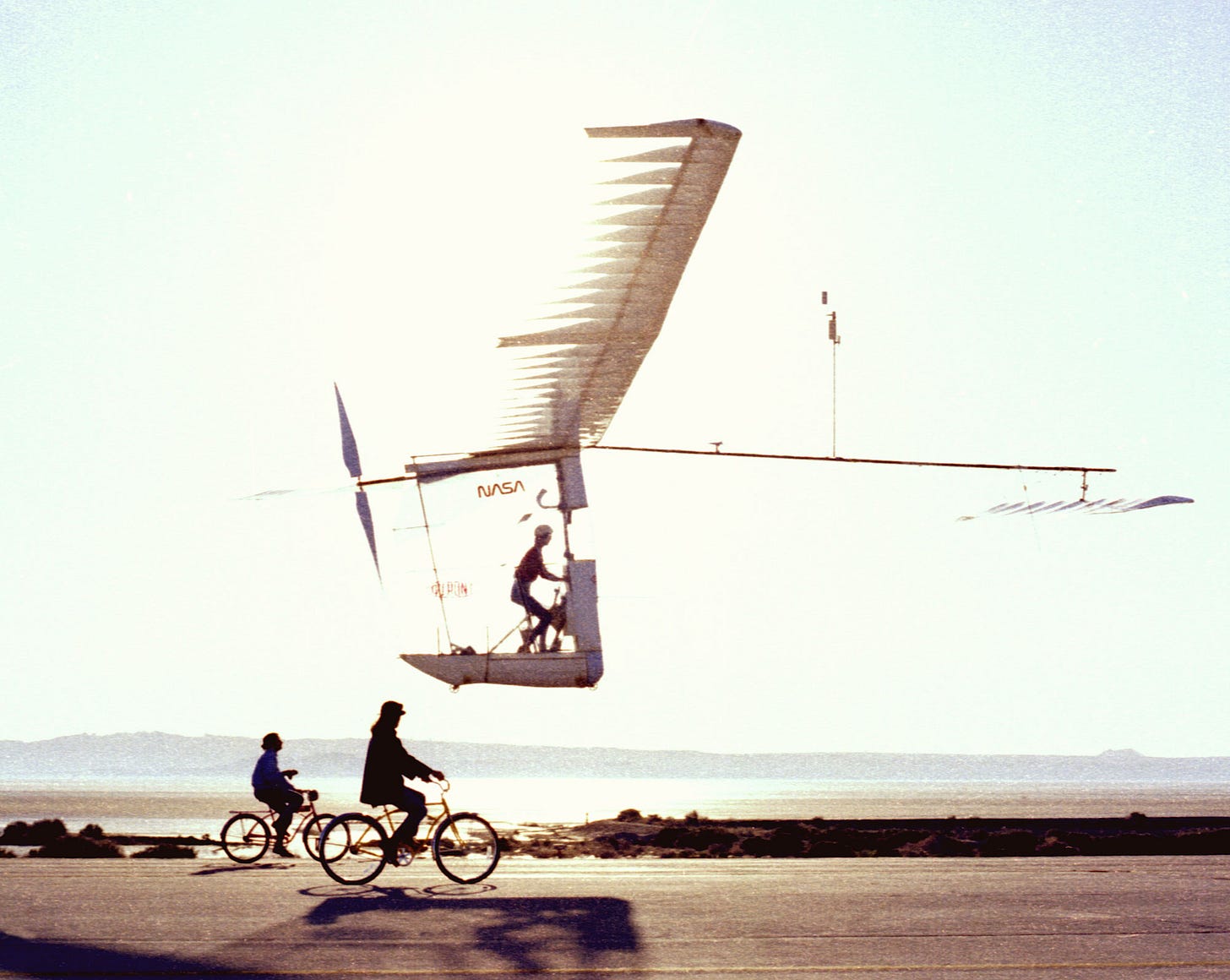
The Gossamer Albatross II on a test flight at NASA's Dryden Flight Research Center in Edwards, California (Source: NASA).
The professional teams before him followed the rules of engineering. If this art made supersonic flight and landing on the moon possible, this seemingly simple problem could indeed be solved with it. However, the problem was more complex than initially thought. The same analytical approach to engineering that had continually improved aircraft construction over the decades could not deal with the complexity of human-powered flight.
Paul MacCready followed his instincts and approached this problem more empirically (also due to a lack of alternatives) than his more analytical competitors. He concentrated his minimal resources on the essentials and omitted everything else. The airplane didn’t have to be fast or nice-looking; it just needed a large wingspan for a lot of lift with as little weight as possible because human muscle power was the limiting factor. To learn quickly from experiments and try out modified designs, it had to be simple to build and easy to repair, as Greg McKweon summarizes the approach with quotes from a lecture by Paul MacCready at MIT12:
The real challenge was not to build an elegant plane that could fly the figure eight around the two posts on the field but to develop a large, lightweight plane, “no matter how ugly it is,” that could be “repaired, modified, changed and redesigned again after a crash—and quickly.” At that moment, he suddenly realized: “There’s an easy way to do it.”
Anyone who has spent many years of their education and professional life successfully using a hammer on different types of nails will find it challenging to recognize the screw and change the tool. At first glance, the Kremer Prize appeared to be a rather complicated problem—or at least the experienced engineers thought it was. In reality, however, the complexity was dominated by the restriction of a single parameter, namely, powering it solely through the muscle power of a person. It was only through the empirical approach of trial and error that Paul MacCready, as a layman, succeeded in doing what the experts before him had been denied for so long.
The Eighth Type of Waste
However, Paul MacCready’s story also shows how much untapped potential there tends to be in people. If he hadn’t been motivated by his debts, perhaps he would have just done his regular job well and built a few model airplanes with his children in his spare time.
The extraordinary story of how the first BMW 3 Series Touring came about is similar. Max Reisböck had a problem in 1984: his employer’s brand strategy did not suit his family’s needs as BMW did deliberately not have a hatchback in its model catalog, and the notchback version of the 3 Series was too small for his growing family. So, the trained car body maker, who had already been working in prototype construction at BMW for several years, quickly turned an E30 notchback saloon into the first BMW 3 Series Touring13 in his spare time. Unfortunately, this remarkable achievement did not solve his problem in the short run. When his prototype was presented at the headquarters in Munich, the then Chairman of the Board of Management, Eberhard von Kuehnheim, and his Head of Development, Wolfgang Reitzle, immediately recognized the potential of this model and ordered appropriate secrecy for further development until it was ready for series production: “This car will not leave the company grounds.”14
In Lean Management, there are seven classic types of waste. These seven are frequently, and as Paul MacCready and Max Reisböck’s examples show, quite rightfully, supplemented by an eighth type of waste: the unused potential of employees. Harnessing human potential and creativity for continuous improvement is a key principle of Lean Management. In this respect, this eighth type of waste underlies and complements the other seven.
The rise of Toyota after the Second World War is inextricably linked with the name Taiichi Ohno. He was instrumental in shaping and developing the Toyota Production System. What is understood today as Lean Manufacturing and more general as Lean Management can largely be traced back to him. Toyota succeeded in significantly increasing productivity and thus could not only catch up with its American competitors from Detroit but overtake them. The concepts and methods of Lean Management spread in the manufacturing industry and many other areas and sectors, including IT, where the “Manifesto for Agile Software Development”15 can be understood as applying Lean Management principles to the software development process.
In many factories, overproduction of semi-finished and finished products was common. These buffers allow quality fluctuations during production (and in the supply chain) to be compensated for to a certain extent and to avoid effects on quality and delivery dates. Because these buffers are so practical and seemingly indispensable, this type of waste is often not even recognized as such. Nevertheless, the hidden costs of inventory, storage space, and transportation are hard to underestimate.
A central element of Lean Management is, therefore, the elimination of waste. This means avoiding wasteful activities, i.e., activities that do not generate any value, which is a better translation of the Japanese term muda than waste. Traditionally, there are seven types of muda, as shown in this graphic:
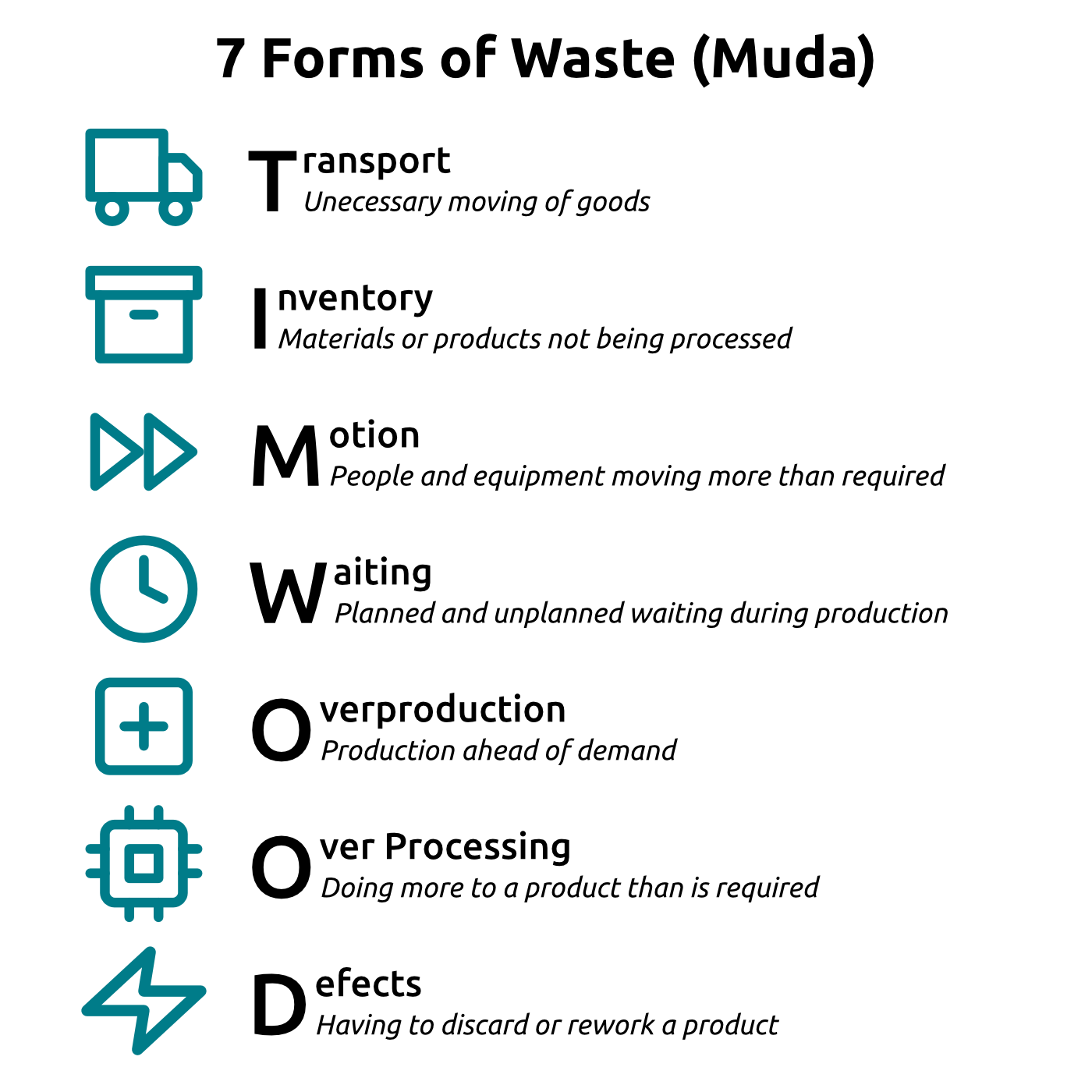
The seven types of waste (muda) in Lean Management
Those seven types all relate to processes. They describe symptoms of weaknesses in work processes, the causes of which must be found and eliminated. Continuous process improvement, also known under the Japanese term Kaizen, is an essential element of the Toyota Production System. In contrast to the very Tayloristic view that prevailed at the time, however, this continuous improvement in Lean Management is not reserved for the manager but is the task of the “ordinary” workers—a small but significant difference.
Avoiding the seven types of waste requires the creativity of everyone involved in these processes. Managers’ central task is to empower these previously “ordinary” workers and train them to do so. In essence, Taiichi Ohno was concerned with developing this untapped human potential.
To emphasize this, unused human potential or unused creativity is often regarded as the eighth type of waste. Rightly so, because organizations are still run like machines, and people in them are treated like cogs whose skills are not in demand beyond their current job description. This eighth type of waste undoubtedly has a different character than the other seven, but utilizing creative potential is so crucial in Lean Management that adding this eighth type of waste to the seven classic types makes a lot of sense.
It pays off when human resources finally become human potential.
Respect for People
A lot can be learned from Lean Management: understanding the value for the customer, identifying the value stream, optimizing the flow through the system to avoid unnecessary effort, and, last but not least, ensuring continuous improvement. However, Lean Management is not just about using different and better methods but also about a different management culture. Respect for people is often forgotten as an essential pillar of the Toyota Way16. People are at the heart of Lean Management. Therefore, the central management task is to “empower instead of instruct.” This principle should be disseminated as intensively as the well-known methods of Lean Management.
Toyota’s extremely successful turnaround cannot be explained simply by a brilliant engineer’s invention and introduction of a few groundbreaking concepts, as the heroic story of Taiichi Ohno might suggest at first glance. The foundation of this transformation was a change in management culture that put people and their creativity front and center. The individual worker was no longer a passively affected object but became an actively shaping subject, as Taiichi Ohno clearly expressed17: “Standards should not be forced down from above but rather set by the production workers themselves.”
Yoshihito Wakamatsu, who worked directly under Taiichi Ohno for many years, reported the following anecdote, which shows how serious Taiichi Ohno was about this empowerment18: During a visit to a Toyota plant, Ohno was accompanied by a manager from another company. This manager noticed some things that could have been improved in the implementation of the Toyota Production System and asked Ohno why he had not corrected them immediately. Ohno’s answer was:
I am being patient. I cannot use my authority to force them to do what I want them to do. It would not lead to good quality products. What we must do is to persistently seek understanding from the shop floor workers by persuading them of the true virtues of the Toyota System. After all, manufacturing is essentially a human development that depends heavily on how we teach our workers.
This response is an excellent example of a vital attitude of humane leadership, which is less about correcting, guiding, or instructing but instead means empowering. Correcting processes from the outside would only cure the symptoms in the short term but would not result in a healthy organization.
This empowerment makes the individual worker an active shaper of continuous improvement, and the resulting broad impact made a decisive difference in Toyota’s transformation. This needs to be recalled today when agile transformations in many companies are reduced to introducing blueprints and frameworks.
Therefore, the ‘e’ in Lean and Agile stands for empowerment, or at least it should. Unfortunately, both philosophies, which are related and build on each other, are often reduced to visible practices, methods, and tools. However, anyone who introduces these without simultaneously working on the foundations of the human image and leadership attitude is building on sand. Richard Feynman aptly describes the result of this reduction as a “cargo cult,” i.e., the beautiful imitation (in his case of scientific work) without a deeper understanding of the purpose and the bigger picture19:
In the South Seas, there is a cargo cult of people. During the war they saw airplanes land with lots of good materials, and they want the same thing to happen now. So they’ve arranged to imitate things like runways, to put fires along the sides of the runways, to make a wooden hut for a man to sit in, with two wooden pieces on his head like headphones and bars of bamboo sticking out like antennas–he’s the controller–and they wait for the airplanes to land. They’re doing everything right. The form is perfect. It looks exactly the way it looked before. But it doesn’t work. No airplanes land. So I call these things cargo cult science because they follow all the apparent precepts and forms of scientific investigation, but they’re missing something essential because the planes don’t land.
The self-organizing team is at the heart of Agile. It is explicitly called for in the principles behind the Manifesto for Agile Software Development20: “The best architectures, requirements, and designs emerge from self-organizing teams.” And so that there is no doubt about the leadership attitude that goes hand in hand with this, it also says: “Build projects around motivated individuals. Give them the environment and support they need, and trust them to get the job done.” There is no such thing as an agile team without self-organization and empowerment, even if frameworks or blueprints have been copied and rolled out exemplary and the processes are celebrated ideally. As long as Agile is imposed on people from above without the necessary empowerment and the necessary change of leadership attitude, it will end in a soulless cargo cult.
As with Toyota and Lean Management, the key to a successful agile transformation lies less in choosing or designing the right frameworks, processes, methods, or tools, an exercise that, unfortunately, is very appealing to managers and consultants, and much more in empowerment and self-organization. Employees must be seen as active subjects of the transformation and, ultimately, of their organization instead of being degraded to passive objects and mere target groups of intrusive change management measures.
Super Chicken
The human element in a digital world is not just an individual matter but a question of culture and organization. A group of super talents does not make a good team. On the contrary, many strong egos can become dysfunctional as a team. This applies not only to soccer teams but also to chickens.
In her TED talk “Forget the pecking order at work”21, Margaret Heffernan reports on an impressive experiment. William Muir from Purdue University investigated the productivity of chickens, which can be measured simply in the number of eggs. He selected only the top performers for the first group and ensured that only the best of these super chickens reproduced. This was contrasted with a second group of average chickens that were not further selected or influenced. After six generations, the chickens in this control group were well-fed and fully feathered, and their productivity had increased slightly. Contrary to naïve expectations, the situation was somewhat different in the group of super chickens: all but three were dead—pecked to death by the others.
The explanation for the experiment’s surprising outcome at first glance is quite bland. The higher productivity of the super chickens went hand in hand with their ability to assert themselves against others at the food bowl. The targeted selection of precisely these individuals reinforced this characteristic of aggression and competitive behavior from generation to generation. However, those who fight each other may prevail as individuals but waste energy as a group. The extreme focus on individual excellence encourages competition and dysfunctional teams. Unfortunately, companies, school systems, and entire societies are built on this principle.
Google also realized that superstars alone do not make a team. As part of “Project Aristotle,” the company investigated what turns a group of people into an effective team. The most important element by far turned out to be psychological safety22. Effective teams have a high degree of safety, so members dare to speak their minds openly and take risks. This is the crucial ingredient that makes the whole more than the sum of its parts–and, therefore, fostering psychological safety is an essential leadership task. It takes this sense of security and trust to generate excellent ideas, as Margaret Heffernan explained in her TED talk with the following beautiful analogy23:
And that’s how good ideas turn into great ideas because no idea is born fully formed. It emerges a little bit as a child is born, kind of messy and confused but full of possibilities. And it’s only through the generous contribution, faith and challenge that they achieve their potential.
-
Gordon E. Moore, “Cramming More Components onto Integrated Circuits, Reprinted from Electronics, Volume 38, Number 8, April 19, 1965, Pp.114 Ff.,” IEEE Solid-State Circuits Society Newsletter 11, no. 3 (2006): 33–35, https://doi.org/10.1109/N-SSC.2006.4785860. ↩
-
David J. Snowden and Mary E. Boone, “A Leader’s Framework for Decision Making,” Harvard Business Review, November 2007, https://hbr.org/2007/11/a-leaders-framework-for-decision-making. ↩
-
Errol Morris, “The Anosognosic’s Dilemma: Something’s Wrong but You’ll Never Know What It Is (Part 1),” Opinionator (blog), June 20, 2010, https://opinionator.blogs.nytimes.com/2010/06/20/the-anosognosics-dilemma-1/. ↩
-
Justin Kruger and David Dunning, “Unskilled and Unaware of It: How Difficulties in Recognizing One’s Own Incompetence Lead to Inflated Self-Assessments.,” Journal of Personality and Social Psychology 77, no. 6 (1999): 1121–34, https://doi.org/10.1037/0022-3514.77.6.1121. ↩
-
Snowden and Boone, “A Leader’s Framework for Decision Making.” ↩
-
Mark Lambertz, Die intelligente Organisation: das Playbook für organisatorische Komplexität, 2. Auflage (Göttingen: BusinessVillage, 2019), 40f. ↩
-
Russell L. Ackoff, “Systems Thinking and Thinking Systems,” System Dynamics Review 10, no. 2–3 (June 1, 1994): 180, https://doi.org/10.1002/sdr.4260100206. ↩
-
Snowden and Boone, “A Leader’s Framework for Decision Making.” ↩
-
A.H. Maslow and John Dewey Society, The Psychology of Science: A Reconnaissance, Gateway Edition (Harper & Row, 1966). ↩
-
“Kremer-Prize,” on Wikipedia, February 9, 2024. ↩
-
“Kremer-Prize.” ↩
-
Greg McKeown, Effortless: Make It Easier to Do What Matters Most, First edition (New York: Currency, 2021), 126. ↩
-
Wolfram Nickel, “BMW 3er Touring E30: Und plötzlich waren Kombis cool - WELT,” DIE WELT, September 27, 2017, https://www.welt.de/motor/fahrberichte-tests/oldtimer/article168818064/Und-ploetzlich-waren-Kombis-cool.html. ↩
-
Max Reisböck himself tells this story best in this official BMW video (in German) Max Reisböck BMWstory. Erfinder des BMW 3er Touring., 2015. ↩
-
Beck et al., “Manifesto for Agile Software Development.” ↩
-
Toyota Motor Corporation, “Toyota Way 2020 / Toyota Code of Conduct,” Toyota Motor Corporation Official Global Website, 2020, https://global.toyota/en/company/vision-and-philosophy/toyotaway_code-of-conduct/index.html. ↩
-
Taiichi Ohno, Toyota Production System: Beyond Large-Scale Production (CRC Press, 1988), 98. ↩
-
Yoshihito Wakamatsu, The Toyota Mindset: The Ten Commandments of Taiichi Ohno (Enna Products Corporation, 2017). ↩
-
Richard Feynman, “Cargo Cult Science,” Engineering and Science 37, no. 7 (June 1974): 10–13. ↩
-
Beck et al., “Manifesto for Agile Software Development,” https://agilemanifesto.org ↩
-
Margaret Heffernan, “Forget the Pecking Order at Work,” https://www.ted.com/talks/margaret_heffernan_forget_the_pecking_order_at_work ↩
-
Charles Duhigg, “What Google Learned From Its Quest to Build the Perfect Team,” The New York Times, February 25, 2016, sec. Magazine, https://www.nytimes.com/2016/02/28/magazine/what-google-learned-from-its-quest-to-build-the-perfect-team.html ↩
-
Heffernan, “Forget the Pecking Order at Work.” ↩