The 14 Principles Behind the Manifesto
The six theses of the Manifesto for Humane Leadership are deliberately kept open. They are a frame that is very broad but gives a rough direction. They are an invitation to reflect on leadership in general and your leadership style in particular. However, as with the “Manifesto for Agile Software Development”, more concrete and actionable principles underlie these theses.
People are at the Center
Companies are more than just places of value creation and profit maximization. Profit is not an end in itself; it is to companies what air is to humans: we breathe to survive, but a fulfilled life is not just about breathing.1 Profit is only a necessary condition for the continued existence of the organization and the proof that the organization satisfies an important need for customers, as Peter Drucker notes: “Profit is not the explanation, cause, or rationale of business behavior and business decisions, but rather the test of their validity.”2
Economic success is the result of the development of human potential. “Business means working for each other. People are the purpose,” Götz W. Werner unequivocally comments in his autobiography.3 People are not just a means and resources but are at the heart of economic activity. Fully developing people’s abilities within the organization is the decisive competitive factor. The company is, therefore, what Bodo Janssen aptly describes as a “workshop for a flourishing life”4 and appropriately quotes the Regula Benedicti (4.78):5
However, the workshop in which we are to carefully realize all this is the monastery and the permanence within our community.
This sentence ends the fourth chapter of the Regula Benedicti, written by St. Benedict of Nursia around 540 to regulate monastic life in the community monastery he founded at Monte Cassino. Since then, this set of rules has formed the basis of the Benedictine order. And since Bodo Janssen stayed in various Benedictine monasteries, the Regula Benedicti has also inspired and guided him in transforming his Upstalsboom hotel chain into a workshop for a flourishing life.
The term workshop raises the question of which instruments are used there. Benedict of Nursia also provides the answer in this fourth chapter in the form of 73 “instruments of good works.” These instruments are more like good habits and provide the “answer to the question: What can I do every day to ensure that my life is successful, that I enjoy my time with my work and the people around me?”6
Even 1500 years ago, the principle of eye level was of central importance to Benedict of Nursia—which was at least as radically different in the feudal order of the early Middle Ages as we perceive it today in the hierarchical culture of our organizations. While our actions are often guided by the ego-oriented question, “What do I gain from the existence of others and the community?” Benedict of Nursia was concerned with the opposite question: “What does the community gain from my existence?” Such a community, therefore, has much more the character of a network than that of a hierarchy, and this network lives from individual contributions. In the words of Regula Benedicti (72.7), “Let no one look to their own interests, but rather to the interests of others.”7
Start With Self-Care
Anyone responsible for others must first manage their physical and mental resources responsibly. If you sacrifice yourself and constantly overtax yourself, you will also overtax the organization and the people entrusted to you. The result is a culture of hysterical busyness in which work becomes a vain end in itself.
We all know such a (predominantly male) colleague or boss: he is always the first to arrive and the last to leave. He doesn’t get tired, and he ignores illness. Four hours of sleep must be enough; there is so much to do, and his skills are needed everywhere. He would also like to go on vacation, but it just doesn’t work without him. That’s why he is always available. His commitment to the company knows no bounds. His hard work is legendary and the driving force behind his rapid rise in the company.
The history of humankind is full of heroes. We love heroic stories. That’s why we admire firefighters who risk their lives to put out fires and rescue people. We pay far less attention to the countless fire safety officers who calmly and patiently prevent fires daily and thus save more people. Without smoke and danger to life, there is no heroism. Prevention is not very heroic.
There are undoubtedly situations that require total and sometimes heroic commitment. However, firefighters only work like this when deployed, which is the exception. Firefighters spend most of their time waiting, preparing themselves and their equipment, learning, and practicing. And that’s a good thing because being constantly on duty would lead to life-threatening mistakes.
Let’s come back to our “hero.” He sacrifices himself for his organization, work, career, and status, not just in an emergency but in principle and always. Undoubtedly, this is not healthy, but in the end, adults are still free to decide what risks they take in life. Beyond the personal sacrifice and the associated risk to health, the question remains whether this heroic commitment is worthwhile for the organization and deserves admiration and promotion.
Hopefully, he will achieve and move a lot with his efforts. Let’s assume in his favor that our hero has superhuman abilities and can still do an excellent job on long working days with little sleep. But even under this very benevolent assumption, another severe problem remains. The behavior of such a boss shapes the culture. In this case, it leads to an unhealthy cult of presence and performance. Ambitious employees will do the same and try to outdo him because diligence and unconditional commitment are, in such a culture, essential for recognition and promotion.
However, no one will be satisfied and thrive in the long run in such an excessive performance culture, not even our hero. Instead, the atmosphere will be characterized by pressure, fear, guilt, and bitterness, as Anselm Grün very aptly points out:8
Anyone who takes responsibility for others must also be responsible with their own resources. If they constantly overtax themselves, they will not help the community. Because they will then demand more from the community than it can provide. If I spend myself on others, I unconsciously will make demands on them, for example, that they should thank me for it or show the same level of commitment. If the community does not fulfill these expectations, I become bitter. My work will then become a constant reproach to the community and cause feelings of guilt in my coworkers.
Leadership begins with self-care. Anselm Grün rightly demands that those who take responsibility for others must also deal responsibly with their own capacity. A leader who is at peace with himself and goes about his work with serenity and composure will also be imitated and will thus create a serene and safe atmosphere.
Strengthen Strengths
Leadership aims to empower people, letting them grow instead of keeping them down. Thus, leadership means strengthening strengths and making individual weaknesses irrelevant.
Everyone is a genius. But if we judge a fish by how well it can climb a tree, it will spend its whole life thinking it is stupid. This saying is often attributed to Albert Einstein. Although there is no evidence for this, it fits Einstein’s life perfectly: he began to speak at the age of three, and although he was not bad at school, especially in the natural sciences, he was no child prodigy either. His strengths remained undiscovered for a long time. At the time of his groundbreaking first publications in his Annus Mirabilis in 1905, he was an assistant examiner at the Swiss Patent Office. In fact, this position was already a success. Before, he had to work as a tutor after all his applications for assistant positions at the Federal Polytechnic School in Zurich (later the Eidgenössische Technische Hochschule, ETH) and other universities were rejected.
In his book “The Effective Executive,” Peter Drucker devotes an entire chapter to making strengths productive.9 His basic assumption is that everyone has some individual strengths—and many weaknesses. So far, so painfully recognizable in our daily encounters. The essential question is how to deal with these weaknesses. It all starts with admitting that weaknesses are unavoidable, as Peter Drucker clearly states:10
The idea that there are “well-rounded” people, people who have only strengths and no weaknesses (…) is a prescription for mediocrity, if not for incompetence. Strong people always have strong weaknesses too.
However, we have been trained to focus on our shortcomings since our early school days. In job interviews, we are asked about our most significant weaknesses. In each annual appraisal, we discuss our areas of improvement—all to achieve the most well-rounded profile of skills possible. However, according to Peter Drucker’s argument, this almost inevitably leads to strengths atrophying and not being fully utilized while we develop our weaknesses to the point of mediocrity at best. The result is a well-rounded profile with no great depths—and no great heights. His advice is therefore:11
To make strength productive is the unique purpose of organization. It cannot, of course, overcome the weaknesses with which each of us is abundantly endowed. But it can make them irrelevant. Its task is to use the strength of each man as a building block for joint performance.
Individual weaknesses must be balanced for the organization’s optimal performance, but not individually, as a private, local optimum. In an orchestra, no one would think of telling the tuba player that he has a weakness in playing the violin and telling him to work on it next year, to stay with the image of the orchestra that Peter Drucker likes to use (see Section “Species-Appropriate Keeping of Knowledge Workers”).
Leadership begins with leading yourself, i.e., with knowing yourself and accepting yourself with your strengths and weaknesses. It is about remaining true to yourself without constantly emulating other people or an abstract and well-rounded ideal, which is undoubtedly a much more significant challenge today in the age of social media than it was in Peter Drucker’s days. But precisely for that reason, it is all the more important to “be yourself; everybody else is already taken,” as Oscar Wilde quipingly noted.
Recognizing your strengths and weaknesses does not come naturally to anyone but results from systematic reflection. Effective managers set goals for themselves as they do for their business and regularly review their performance. Peter Drucker recommends a simple but effective method for systematically recognizing your strengths, the so-called feedback analysis: “Whenever one makes a key decision and whenever one takes a key action, one writes down what one expects will happen. And nine months or twelve months later, one then feeds back from results to expectations.”12
After a few such feedback loops, a clear picture emerges of one’s strengths and which of one’s own thought and behavioral patterns stand in the way of the full development and application of these strengths. Drucker recommends deriving actions in various directions from this analysis: First, focus on and consciously use one’s strengths; second, consistently build on those strengths; third, reduce or eliminate behaviors and habits that run counter to the effective application of strengths; fourth, stop doing things one is not good at; and fifth, waste as little effort as possible on remaining weaknesses.13
Leadership Means Relationship
Families today are already more advanced than many organizations. Most parents now reject the strictly authoritarian, fear-based upbringing that was common a few generations ago. Even though some authors tirelessly uphold discipline and obedience, representatives of educational science are pretty unanimous about the harmfulness of this backward-looking “black pedagogy.”
Instead, Danish family therapist Jesper Juul’s philosophy is that “parenting means relationship.” To achieve this, relationships in the family need a certain quality, for which Juul coined the term “equal dignity,” which he describes as such:14
Equal dignity means both “of equal value” (as a person) and “with the same respect” for the personal dignity and integrity of the partner. In a relationship of equal dignity, both partners’ wishes, views, and needs are taken equally seriously.
Equal dignity is not only about equal rights and obligations. Instead, it refers to recognizing the other community members’ individuality and subjective needs and wishes and granting them the same dignity instead of degrading them to mere objects. In contrast to laissez-faire or democratic approaches, the task of leadership remains with the parents but with the aim of empowering children.
Not only does parenting mean relationship, but leadership in general means relationship. Leadership always takes place in and through relationships between people. We should, therefore, pay close attention to the quality of our relationships and shape them not with fear but with equal dignity. The ultimate goal is also empowerment and self-leadership—in the words of Götz W. Werner: “First and foremost, leadership means raising awareness with the aim of bringing as many employees as possible into an entrepreneurial mindset.”15
For Father Anselm Grün, humility is the most crucial virtue in dealing with people. Humility is not about making oneself small but the courage to face one’s imperfect humanity: “Those who know about their abysses will never put themselves above others.”16 Those who lead with humility treat people with reverence and kindness.
The good word in the sense of the letter to the Ephesians is decisive for this encounter in humility: “Do not let any unwholesome talk come out of your mouths, but only what is helpful for building others up according to their needs, that it may benefit those who listen.” (Eph 4:29)17. Equal dignity relationships are characterized by care, respect, and interest. People grow and flourish in such relationships. They are built up and not weighed down by fear. The good word awakens life—in the individual and the network of equal dignity relationships that forms the organization. Leadership, therefore, means praise, as Anselm Grün describes:18
Anyone who leads others must, above all, master the art of praise. Praise means speaking well of a person (benedicere) and saying good things about them and to them. Those who speak to the good in people also bring it out in them. With that, one motivates people more than through criticism and control.
Context Not Control
What does Netflix have in common with a nuclear submarine? Although the two could not be more different at first glance, their extraordinary management culture is more similar than one might think. Reed Hastings, CEO of Netflix, prides himself on making as few decisions as possible, preferably none at all for an entire quarter.19 So does Captain David Marquet, who decided on the nuclear submarine USS Santa Fe to stop giving orders. Both rely on context rather than control and are incredibly successful.
David Marquet spent over a year preparing for his new role as captain of the USS Olympia. He learned every detail about this particular nuclear submarine. Everything went as planned until he had to take command of the USS Santa Fe at short notice. These two nuclear submarines belong to the same class of nuclear-powered fast attack submarines (Los Angeles-class). Still, as the USS Santa Fe was a much newer type, David Marquet knew relatively little about this submarine when he took command of it. Too little, as it soon turned out.
During an exercise in his first month in command, David Marquet recognized the danger of a team trained to obey combined with a boss whose knowledge was limited. The exercise simulated the failure of the main reactor. For the duration of the reactor repair, the USS Santa Fe had to maneuver with a battery-powered electric propulsion motor. To challenge the crew and increase the pressure, David Marquet finally gave his officer of the deck the command, “Two-thirds ahead!” The officer immediately passed the order on to the helmsman and … nothing happened!
Marquet confronted the helmsman, who explained dutifully, “Sir, we don’t have two-thirds here.” Everyone else on board knew that, too. The officer of the deck knew it in particular, but he passed the order on without hesitation because he was trained to obey. A classic HIPPO moment: “Highest-paid person’s opinion.” But it was also a moment for David Marquet to question himself. He realized that, with his limited knowledge and experience, he was a dangerous bottleneck in the organization. Beyond that, he saw the potential that lay dormant in his team’s collective experience and expertise, intelligence, and creativity.
So he decided not to give any more orders. Besides using the nuclear missiles, David Marquet let his crew make their own decisions. To enable them to make these decisions, he communicated the intention and goal, gave them the full context, and helped them make their decisions increasingly independently by asking specific questions like a coach.
When an officer would ask initially for permission to initiate the dive, for instance, he did not give an order but led him to think about whether it was safe and the right thing to do now regarding the overall mission. Gradually, fewer and fewer officers asked for permission but began to think like the captain and took responsibility for their decisions and the decisions of their teams. Where the crew previously followed commands that were more or less disconnected for the individual, the current situation and the ship’s mission were now clearly understood, even in the rearmost engine room. This understanding of the overall situation led to far better decisions, for example, by avoiding noise in the engine room when an enemy ship was nearby.
David Marquet turned the ship around, which is why his book is titled “Turn Around the Ship! A True Story of Turning Followers Into Leaders”. Through this extraordinary leadership culture, the USS Santa Fe went from being the worst to the best submarine in the US Navy and remained so beyond the end of David Marquet’s service. On top of that, the USS Santa Fe became de facto a training ground for several aspiring captains who learned their trade under David Marquet.20
Despite this impressive demonstration of the effect of leadership focused on empowerment, examples of this leadership culture in large hierarchical organizations are hard to find. At Netflix, the seventh-largest internet company in the world, though, one will quickly find them. And there in particular in the legendary “Culture Statement.”21 The original 125(!) slides on culture at Netflix were viewed over 17 million times and described by Meta Platforms (formerly Facebook Inc.) COO Sheryl Sandberg as “perhaps the most important document ever to come out of the Valley.”22 In the now revised version displayed on the Netflix website, it becomes clear who makes the decisions at Netflix:23
We strive to develop good decision-making muscles at every level of the company, priding ourselves on how few, not how many, decisions senior leaders make. We expect managers to practice context not control—giving their teams the context and clarity needed to make good decisions instead of trying to control everything themselves.
Leadership does not mean deciding everything yourself but creating the conditions that enable employees to make their own decisions. That’s why Reed Hastings prides himself on making as few decisions as possible at Netflix and David Marquet stopped giving orders on the USS Santa Fe.
Leadership means cultivating and demanding self-management of the people entrusted to it. Like gardeners, leaders create a conducive environment for unleashing human potential.
Gardener Not Chess Master
The military is often cited as an example and blueprint for hierarchical organizations. And rightly so, since in the course of industrialization, many companies were indeed inspired by the organization of the military. However, it is often forgotten that the military has long relied on the speed and effectiveness of autonomy and self-organization, especially in complex and unclear situations.
The Prussian Field Marshal Helmuth Graf von Moltke (1800-1891) already recognized: “No operational plan extends with any certainty beyond the first encounter with the main enemy force.”24 He, therefore, granted the subsequent levels of command extensive freedom in executing the combat mission. Ultimately, this led to the extraordinarily successful concept of “mission-type tactics (Auftragstaktik).”25 The decisive advantage of this type of leadership is that decisions are made quickly and autonomously on the front line, trying to accomplish a set mission with clear boundary conditions, whereas previously, information had to travel slowly and erroneously up the hierarchy, and corresponding orders had to travel back down again.
The slowness of central decision-making is one thing; the superhuman demands placed on such central decision-makers is another, as Stanley McChrystal, who led much of the special forces operations in Iraq and Afghanistan from 2003 to 2008 as commander of Joint Special Operations Command (JSOC), points out: “Although we intuitively know the world has changed, most leaders reflect a model and leader development process that are sorely out of date. We often demand unrealistic levels of knowledge in leaders and force them into ineffective attempts to micromanage.”26 Hierarchical decision-making is neither efficient nor effective in our VUCA world. David Marquet also recognized this when he took command of the nuclear submarine USS Santa Fe. As an alternative to this leadership model of the ingenious chess master, Stanley McChrystal suggests thinking more like a gardener:27
The temptation to lead as a chess master, controlling each move of the organization, must give way to an approach as a gardener, enabling rather than directing. A gardening approach to leadership is anything but passive. The leader acts as an “Eyes-On, Hands-Off” enabler who creates and maintains an ecosystem in which the organization operates.
What McChrystal describes here is a radically different understanding of leadership than we are used to in Taylorist, hierarchical organizations. Managers there usually act like chess masters, thinking through and controlling every move; this is how the manager’s role was designed: omniscient, planning, and controlling. In the chess master’s worldview, the chess figures are just stupid puppets, and he is the hero.
The gardener’s understanding is much more modest: a gardener knows he cannot produce tomatoes or cucumbers himself. He can only create and maintain an environment in which those plants thrive. He is also not the best and most efficient tomato and was promoted to manager because of these skills. As a gardener, he has and needs different skills. That is the difference between management and leadership. And that is precisely what makes a difference today.
Unfortunately, the classic development path in traditional companies often follows a different and relatively simple logic. If you perform outstandingly as a specialist, you get promoted. It almost seems as if leadership qualities such as empathy and trust are secondary to exceptional professional qualifications. As a result, the new boss often remains his best employee, which hinders his and his team’s progress.
The task of the tomato plant is to grow and produce tomatoes; the gardener creates the necessary conditions for this. The specialist’s task is to gather knowledge and experience to solve problems and ultimately generate value. Leadership creates the proper environment in which this work can succeed today and even better tomorrow and the day after tomorrow. Sundar Pichai, CEO of Google, sums up his understanding of leadership in this way:28
As a leader, a lot of your job is to make those people successful. It’s less about trying to be successful (yourself), and more about making sure you have good people and your work is to remove that barrier, remove roadblocks for them so that they can be successful in what they do.
Good leadership has a leverage effect by making others successful and effective. Leaders who remain too much specialists—and, in the worst case, their best employees—neglect this leverage effect and thus their actual (new) task. The best tomato does not simply become a good gardener; at best, it becomes a kind of senior tomato who explains the trade to the junior tomatoes and, in doing so, enjoys this expert role far too much.
Principles Not Rules
Lenin made the unfortunately not entirely unfounded observation: “Revolution in Germany? It’ll never work; when those Germans want to storm a train station, they’ll buy a platform ticket!”
Everything has to be in order here in good old Germany.
That’s why lawn edges are so popular in Germany. And that’s why the myth persists that most of the world’s tax literature concerns German tax law. We are well known and appreciated for our conscientiousness and sense of order, even if we occasionally overdo it. Our relationship with creative chaos is strained, to put it mildly.
Of course, there are always good reasons for another rule, a new instruction, or a new process. After all, every eventuality must be considered, every special case regulated, and every abuse prevented.
Where would we end up otherwise?
Good question. That’s why the Dutch traffic planner Hans Monderman went and looked, for example, at the busiest intersection in Drachten, where two two-lane main roads meet. Every day, 22,000 cars, 5,000 cyclists, and numerous pedestrians pass this crossing (as of 2005).29 Of course, rules, signs, markings, traffic lights, and a clear spatial separation of cars, cyclists, and pedestrians are needed. Everything must be regulated. However, when we treat people like children, they behave like children, or in the words of Hans Monderman: “When you treat people like idiots, they will behave like idiots.”30
This overregulation is unnecessary, as Monderman proved with his shared space concept. No cycle lanes, road markings, right-of-way signs, traffic lights, and not even sidewalks bring order to the chaos. Hans Monderman liked to demonstrate how well this works by walking backward with his eyes closed across one of “his” intersections.31
Where rigid rules no longer regulate coexistence, confusion reigns. That is precisely the goal because now, people have to think and communicate. There is much more eye contact, and everyone pays more attention to other people instead of traffic lights and their own right of way. This concept has led not only in Drachten but also in various other cities with the shared space concept to lower speeds and, as a result, to a better flow of traffic and significantly fewer accidents, for example, in the Danish town of Christianfield, where fatal accidents fell from three to zero per year following the removal of traffic lights and signs. In the UK, several cities removed the center line on the road, and a study found that 35% fewer accidents occurred.32
Let’s focus more on shared values and fundamental principles not only on the streets but also in our organizations. Instead of a plethora of rules, let’s trust the people and their good judgment, as Laszlo Bock, formerly Senior Vice President of People Operations at Google, aptly points out:33
Give people slightly more trust, freedom, and authority than you are comfortable giving them. If you’re not nervous, you haven’t given them enough.
Less is More
Perfection is achieved, not when there is nothing more to add, but when there is nothing left to take away. This ideal crafted by Antoine de Saint-Exupéry reveals some potential for refinement in public administration and large corporations. Wherever many people collaborate, rules grow wildly and processes become more complicated.
What happens to the administration when there is less actual work? Cyril Northcote Parkinson asked himself this question. The subject of his investigation was the British Colonial Office, an independent department of the British administration responsible for the administration of the British colonies from 1854 to 1968. Parkinson found that the staff grew regardless of the amount of work; the Colonial Office had the most officials when integrated into the Foreign Office in 1968 due to a lack of colonies to administer. The organization was busy with itself but was not very productive. Parkinson summarized this observation in his law on the growth of bureaucracy:34
Work expands so as to fill the time available for its completion.
Simplification is not the sweet spot for public administration and large corporations. Yet, less is more. Bauhaus architect Ludwig Mies van der Rohe used this famous motto to describe his art. His colleague Richard Buckminster Fuller took a similar view, although he referred to the functional aspects: “Doing more with less.” What sounds so simple, however, is arduous work.
Less is more—especially more work. Not only in architecture. The French mathematician Blaise Pascal apologized for his linguistic overabundance in 1656: “I have only made this letter longer because I have not had the time to make it shorter.”35 His Hungarian colleague Paul Erdős, one of the greatest mathematicians of the 20th century, believed in “The Book,” a book of God, which, in his opinion, contains all the short, elegant, and perfect mathematical proofs.36
So if these great thinkers and artists agree that simplicity is the ultimate sophistication, as Leonardo da Vinci so aptly put it, how does this cancerous growth of public administrations such as the British Colonial Office and its excessive bureaucracy come about? This phenomenon, which can be observed in an almost identical way in large corporations that have grown over decades, regularly results in rather unsuccessful attempts to reduce bureaucracy.
Perhaps we busy knowledge workers are just like Blaise Pascal; we simply don’t have time to streamline our processes. However, the cause of this complication might lie much deeper in our human psyche. When searching for solutions, we primarily prefer to add new elements instead of removing parts, even if the latter would be significantly more efficient or cheaper. At least, that is what research results published in the journal “Nature” suggest.37

In one experiment, participants were tasked with improving the stability of a LEGO building so that the roof would ultimately support a heavy load put onto it. Participants would receive a dollar if they succeeded, but each additional Lego brick used to stabilize the building cost 10 cents. Since the roof initially rested on a single LEGO brick far off the center, most participants added more bricks to stabilize the roof and support the heavy load. However, it would have been much easier and more profitable to remove the single stone at the edge of the roof, allowing it to rest stably on the rest of the structure.
Removing things doesn’t seem to suit us. We prefer to do more of the same. And if that doesn’t help, then we do even more. “Having lost sight of our goals, we redoubled our efforts,” Mark Twain aptly observed. This universal human tendency combined with German thoroughness also explains the extensive German tax legislation and the finely chiseled travel expense guidelines in our companies.
Bureaucracy was also rampant at FAVI, a French die-casting manufacturer. One of the rules was that if a worker wanted a new pair of gloves from the warehouse, he had to show his supervisor the old pair and then receive written confirmation from him, which the worker had to hand in at the warehouse to get a new pair.
When Jean François Zobrist found a worker waiting outside the warehouse during a factory tour, he did the math and found out that this worker was operating a machine that cost 600 francs per hour, or ten francs per minute. Since the whole process of issuing new gloves took ten minutes, during which the machine was idle, the gloves, worth 5.80 francs, cost the company an additional 100 francs through this control mechanism.38
So Jean François Zobrist abolished these and many other rules and organized FAVI into mini-factories of 15-35 employees, who made all decisions for their respective customers (including the previously centralized functions of Sales, Planning, Engineering, HR, etc.). Here, too, fewer (uniform) rules did not lead to the feared chaos but to more personal responsibility and self-organization. The success of this transformation was remarkable: FAVI subsequently managed to grow from 80 to over 500 employees and continued to produce profitably in Europe with its above-average wages, where other suppliers had long since relocated production to the Far East.39
Questions Not Answers
Children ask questions—lots of them. But at some point in school, they ask fewer and fewer questions. Only the correct answers to the teacher’s questions count from then on. And so it goes on in professional life. Whoever is at the top and standing in front gives the answers, and those further down or at the back should better not ask too many questions.
Questions are a great way to better understand the world from different perspectives; this is why children ask so many questions—until they are systematically discouraged from asking them.
Who, What, Where, When, Why, How? If you don’t ask, you stay stupid. This theme of “Sesame Street” has been getting to the heart of the matter for generations. Today, we need more of these questions than ever to understand the interrelationships in an increasingly global and complex world, not only in schools but also in the economy and society. Instead, we have become comfortable in our consumer attitude and demand quick and easy answers from “those up there,” whether as citizens or employees.
However, these answers rarely lead to insight but rather to dissatisfaction. Everyone has an opinion in the coffee kitchen and at lunch—usually not a good one. Criticism is always quickly practiced. However, the idea of asking questions to understand the communicated answer and position rarely occurs to anyone. The pattern of proclamations from above and obedience without true conviction further down is too well-rehearsed, and the awe and fear are often too great.
This sluggish cycle also causes dissatisfaction at the top. Therefore, much time and money is invested in communication and change management to improve the dissemination and reception of the given answers. Unfortunately, not many people at the executive level think about opening up other perspectives and solutions by asking sincere questions before giving their answers. The self-image that strong leadership must provide answers and that asking questions suggests incompetence and weakness is too deeply ingrained.
So, everyone remains more stupid than necessary. At the top, people miss better perspectives and creativity in finding solutions. At the bottom, they only see the final and nicely packaged answer, but rarely the questions and the process leading to this answer.
He who asks, leads. This is a golden rule in sales. Answers regarding the features and benefits of a product or service are more likely to be accepted if they fit the customer’s situation and problem and make sense from an individual perspective. That’s why good salespeople ask many questions and only allow the product’s benefits to flow into the conversation. Talented salespeople do this authentically and unobtrusively so that the customer does not feel manipulated or pressured but understood and well-advised.
Conversely, it is also true that those who lead should ask questions. Asking questions is not a sign of weakness but wisdom. Socrates is credited with saying: “I know that I know nothing!” One of his favorite methods was asking questions to help himself and others gain wisdom. For him, being aware of the limits of his knowledge was a piece of wisdom: “I am wiser than this man, for neither of us appears to know anything great and good; but he fancies he knows something, although he knows nothing; whereas I, as I do not know anything, do not fancy I do. In this trifling particular, then, I appear to be wiser than he, because I do not fancy I know what I do not know.”40
But not all questions are the same. It depends on the attitude. If you ask to confirm your opinion, you already have your answer and don’t learn anything; you are just manipulative. Good questions enable a dialog at eye level. Edgar H. Schein calls this Humble Inquiry in his book of the same name and means asking questions without prejudice, with a genuine interest in the other person’s perspective and opinion:41
Humble Inquiry is the fine art of drawing someone out, of asking questions to which you do not already know the answer, of building a relationship based on curiosity and interest in the other person.
However, instead of enabling constructive dissent, closed questions are often (unconsciously) used to confirm one’s position pseudo-democratically. So instead of asking, “Do we want to do it this way now?” or “Is that okay?” and being happy about the broad agreement, a more humble formulation and open question such as “What could we do to improve this even further?” would be much more inviting. Or perhaps “On a scale of 1 to 5, how confident do you feel about the proposal?”
Anyone who asks questions in this way and is able to listen, even if the answers may contradict their opinion, will significantly strengthen the relationships and nurture a climate of psychological safety, which, according to Google, is essential for team success (see Section “Diversity and Dissent”). Effective teams have high psychological safety, so members dare to speak their minds openly, show themselves vulnerable, and take risks.
This psychological safety paves the way for an open learning culture, which is at the heart of the impressive transformation at Microsoft under its CEO, Satya Nadella. He aptly describes the central challenge as transitioning from a know-it-all to a learn-it-all culture.42 Those willing to constantly learn automatically ask more questions and are less likely to fall into the complacency that Risto Siilasma perceived at Nokia after Apple introduced the iPhone: “The unspoken message I heard was: We are Nokia. We invented this industry. Let’s keep doing what we do so well. Nobody does it better.”43
David Marquet also questioned his attitude as captain of the USS Santa Fe and established an entirely new leadership culture when he decided to stop giving orders. He achieved that by training his crew to think and decide like the captain by asking specific questions (see Section “Context Not Control”).
Asking questions instead of giving answers is not a sign of weak leadership but rather strengthens relationships and people. The decisive factor here is an attitude characterized by humility, authenticity, and a genuine interest in the other person’s perspective. This is the only way to create the necessary psychological safety to ask the right questions without fear and to express one’s opinion candidly. The resulting open learning culture protects against complacency and makes organizations fit for the future in our increasingly complex world.
Trust Is the Foundation
Sure, you can lead without trust. For instance, if your name is Caligula, you are a Roman emperor and have deliberately chosen the motto “Oderint, dum metuant!” which means “Let them hate me as long as they fear me!”. At least he was not hiding it and living authentically to his motto.
The resulting obedience may be satisfying for rulers like Caligula, who score high in the classic traits of the dark triad of narcissism, Machiavellism, and psychopathy. Yet, fear and pressure are not at all conducive to the creative peak performance needed in the knowledge work era. Knowledge workers must be managed like volunteers, as Peter Drucker has already demanded (see Section “Species-Appropriate Keeping of Knowledge Workers”), and a key ingredient to that is trust.
We trust another person if, first, the ideas, arguments, and competencies of the other person convince us (logic); second, if we perceive that person as sincerely human (authenticity); and third, if we feel that the other person is primarily concerned about us and the common cause (empathy). For Frances Frei and Anne Morriss, logic, authenticity, and empathy are the three drivers of trustful leadership relationships.44 Trust is only established when all three drivers are balanced. As soon as one of them is deficient, trust is lost, like a three-legged stool that wobbles or falls over if one leg is too short or breaks.
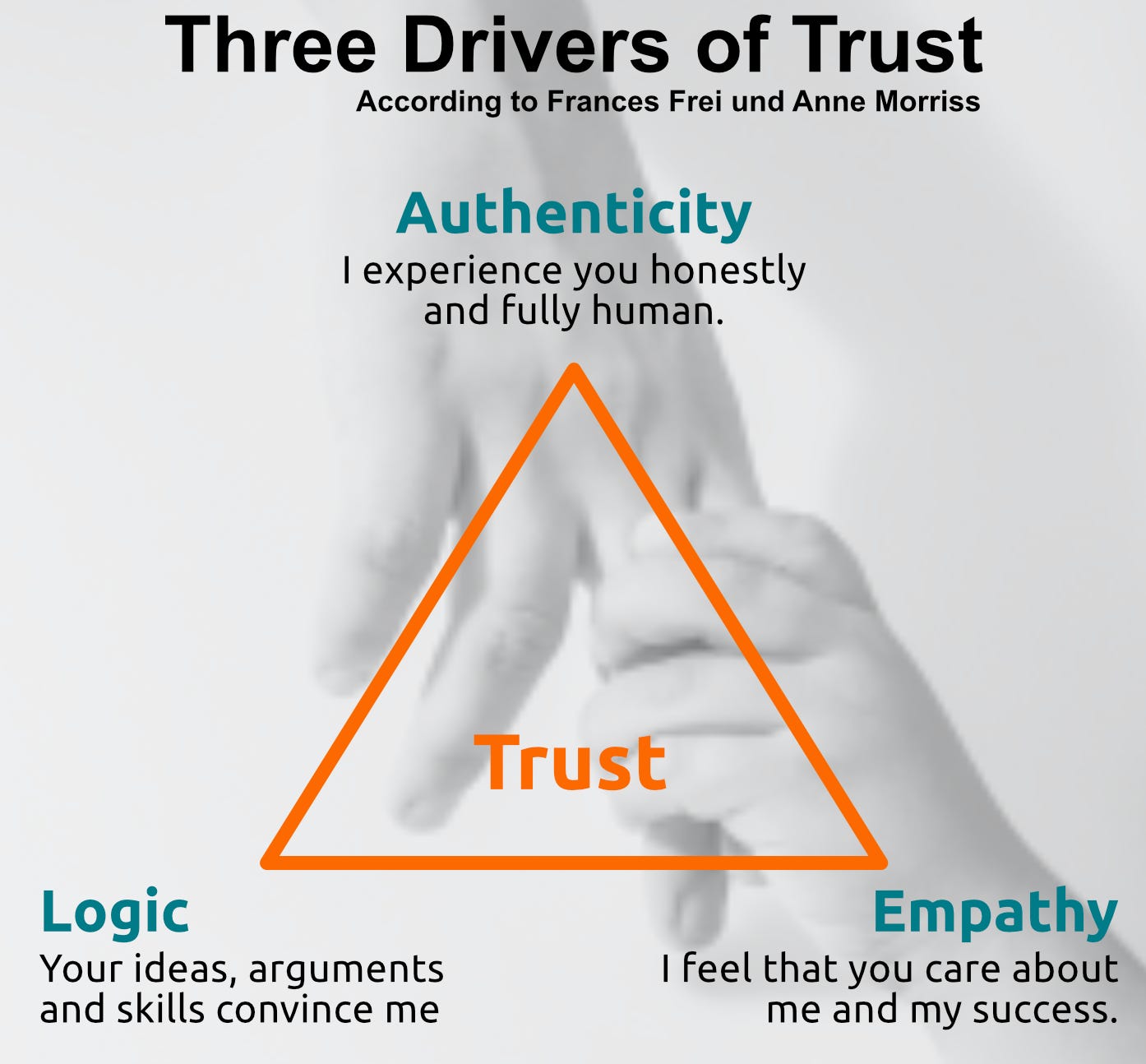
The three drivers of trust according to Frances Frei and Anne Morris.
Leadership has to give orientation. In this respect, the dimension of logic is about visions, ideas, and convincing arguments. The vision’s attractiveness and the argumentation’s coherence naturally play a significant role here. Those who are not convinced will only follow reluctantly.
As a rule, many problems in this area are not due to the actual issue and the pros and cons but rather to presentation and communication. To this end, the two authors recommend simply getting straight to the heart of the matter and only then providing the arguments for it in the further course instead of missing the actual point after a lengthy explanation (and the associated discussion). However, this presupposes that you can clearly state and communicate the core of the matter, which is an art in itself.
Trusting relationships develop between people who are honest with each other in all their vulnerability. If these people, consciously or unconsciously, only play roles, the level of trust remains limited. Conversely, a high degree of authenticity leads to a high level of trust, and people can show all their individuality and develop to their full potential. Frei and Morris are essentially concerned with authentically representing your own position on the one hand and recognizing the resulting diversity of other people’s positions on the other:45
So pay less attention to what you think people want to hear and more attention to what you need to say to them. Reveal your full humanity to the world, regardless of what your critics say. And while you’re at it, take exquisite care of people who are different from you, confident in the knowledge that their difference is the very thing that could unleash your potential and your organization’s.
Empathy is the biggest challenge for many leaders. In hierarchical organizations, leadership too often equals position and power. That is why leadership is too much about ego, assertiveness, and personal advancement. And people sense this. They feel that the leader is not concerned with them as people with their unique talents, needs, and concerns but that, in the end, they are just pawns, bargaining chips, headcounts, and resources.
Sometimes, even small changes in behavior can significantly increase empathy. For example, the two authors suggest observing yourself in meetings. When your interest is satisfied, your commitment drops and your gaze wanders to your smartphone or laptop with your unread emails. The associated signal is clear: My tasks are now more important to me than you, who are here with me in this meeting. In this situation, genuine empathy would mean taking responsibility for the other people in the room and their needs. And that starts with simply putting your smartphone away more often and devoting yourself entirely to the people in the room:46
Signaling a lack of empathy is a major barrier to empowerment leadership. If people think you care more about yourself than about others, they won’t trust you enough to lead them.
Safety Not Fear
Trust and cooperation flourish best in a climate of psychological safety. Only when the members of a group trust each other and feel safe enough to speak their minds openly and take risks can the whole become more than the sum of its parts (see Section “Diversity and Dissent”). Conversely, where competition and fear have been the dominant leitmotifs in the past, achieving adequate unity is impossible.
Organizations are full of contradictions. A fundamental one is that value creation in organizations always depends on cooperation, while the culture is usually geared towards competition. As a result, the desired fruitful cooperation decays into an envious, zero-sum game in which one person’s gain is the other’s loss.
This paradox can be seen in the example of the widespread concept of Management by Objectives. Peter Drucker, who was well aware of the damaging effects of fear and pressure, called it deliberately “Management by Objectives and Self-Control.”47 However, this method for managing knowledge workers, based on self-organization and leading at eye level as early as 1954, quickly deteriorated into dictating goals from above. This misinterpretation is exacerbated by financial incentives that are demonstrably not only ineffective but even counterproductive.48 The fear of missing the targets is an essential ingredient for a culture of antagonism and fear.
The constant fight for budget, headcount, position, influence, power, and prestige causes plenty of frustrating friction even in good times, but on the bottom line, it still works out somehow. In times of crisis, however, the full toxic effect of such a culture, based on competition and fear, unfolds. The threat to the organization from external circumstances (competitors, new business models, a pandemic, etc.) requires internal unity in the fight against it. However, those who do not trust the other department in good times cannot rely on trusting and unconditional cooperation in an emergency. This is why W. Edwards Deming explicitly mentions the reduction of fear as one of the 14 points in his management program:49
Drive out fear, so that everyone may work effectively for the company.
Therefore, Roman emperor Caligula was wrong with his motto “oderint, dum metuant” (let them hate me as long as they fear me). Fortunately, such radical autocrats are no longer common in politics and business today. Nevertheless, fear, competition, and mistrust are deeply interwoven in the culture of many hierarchical organizations. This is why leadership needs to prevent unhealthy competition and instead ensure psychological safety, as Simon Sinek calls for:50
Leadership is the choice to serve others with or without a formal rank. (…) Leaders are the ones willing to look out for those to the left of them and those to the right of them.
“Leadership is a service and not a privilege” is how Father Anselm Grün sums it up in the same way as Simon Sinek, making a lasting impression on Bodo Janssen in a seminar.51 This service includes, in particular, creating a safe environment in which employees can develop without fear. Yet, this is only possible with the appropriate level of self-confidence. In this respect, Father Anselm Grün’s second sentence, which greatly influenced Bodo Janssen at the time, also fits: “Only those who can lead themselves can lead others.”
Leading oneself begins with knowing oneself and accepting oneself in one’s unique being. Unfortunately, many people increasingly feel that they are not enough. They constantly compare themselves and emulate other people or an abstract ideal image. The unique original that we all once were becomes a pale copy.
If people constantly feel insufficient, they seek confirmation and admiration from the outside. This is precisely why social media attracts people and reinforces the tendency to compare oneself with others. Leaders with such an inclination will keep employees small and dependent. Only those who have recognized and accepted their own unique and unadulterated nature can enviously and wholeheartedly develop the unique potential of the people entrusted to them and genuinely rejoice in their people’s success.
In addition to this inner image of how we are and how we should be, we more or less unconsciously hold many other inner images. For example, we can see life as a struggle or a miracle. We can see our work as a hamster wheel and treadmill or as a workshop for flourishing life (see Section “People are at the Center”). We can see employees as lazy or motivated (see Section “Species-Appropriate Keeping of Knowledge Workers”). These inner images, created through upbringing and experience, determine how we interpret the world. Although they might be unconscious, they are still our choice.
Good leadership means approaching your work with hope and inspiring hope in people. To do this, our inner images, in particular, must speak a language of hope. Seeing life as a struggle, the company as a shark tank, and work as an unavoidable treadmill and annoying evil does not inspire much hope. On the other hand, seeing life as a miracle, the company as a place of human encounter, and work as an opportunity for individual development has much more potential for hope.
He Who Says A Does Not Have to Say B
When reality contradicts our beliefs and worldviews, we have manifold ways of resolving this painful dissonance. Astonishingly, most people tend to creatively reinterpret reality so that their perception of reality better conforms to their worldview. Of course, utilizing the contradictions as a source of insight and adapting your worldview and beliefs would be more helpful, especially for leaders.
At midnight on December 21, 1954, a devastating flood was supposed to wipe out all life on Earth. At least, that was the prophecy of Dorothy Martin from Chicago. She had received this warning from extraterrestrials with whom she claimed to be in telepathic contact. But there was also hope: the aliens, with their spaceships, were to rescue her and her small sect, the “Seekers.”
Fortunately for us non-believers, this highly improbable prophecy did not come true. Thanks to Leon Festinger, a 35-year-old psychologist at the University of Minnesota, the story doesn’t end here but only becomes interesting afterward. He doubted that the world would end and wanted to investigate how the people in this sect would deal with the fact that no spaceships would come to save them. He, therefore, infiltrated the sect with his colleagues in the run-up to December 21, 1954.52
How did these people, some of whom had sold their homes and quit their jobs in the hope of imminent salvation from doom, cope with such dismay? Did they lose their faith and send Dorothy Martin packing? Far from it! After a brief moment of horror, the sect found a remarkable way out of their dilemma. They reinterpreted what had happened: Their unshakeable faith had saved the world from devastation and made a rescue by aliens unnecessary.
The sometimes completely irrational suppression and reinterpretation of incongruous facts and events is deeply human. When reality contradicts our convictions, we are capable of remarkable mental contortions. Leon Festinger called this phenomenon the “Theory of Cognitive Dissonance”.53 According to this theory, the dissonance between beliefs and reality causes an unpleasant tension that people try to resolve without giving up, questioning, or correcting their beliefs.
From a rational point of view, it would only be logical to follow Bertolt Brecht’s advice: “He who says A does not have to say B. He can also recognize that A was wrong.”54 In practice, however, it is hard to recognize and admit that you were wrong. Humans prefer to stick steadfastly to their laboriously constructed, more or less skewed worldviews. Even more so when we have already invested substantial time and money into it. This cognitive distortion of sunk costs is well documented and regularly spirals into escalating obligations, whereby further investments are justified with the (sunk) ones already made.
Nevertheless, some people manage to detach from their cognitive dissonance in a way that promotes insight and personal growth. Like Nobel Prize winner Daniel Kahneman, they see the deviation of reality from their beliefs as a welcome opportunity to learn something new:55
I really enjoyed changing my mind because I enjoy being surprised and
I enjoy being surprised because I feel I’m learning something.
In the best empirical tradition, we must measure every theory against reality, and it is only valid as long as observations do not refute it. Shouldn’t this scientific principle also apply to our worldviews and beliefs?
Leading means deciding, sometimes yourself or more and more often—in the sense of this Manifesto—by creating an environment in which proper decisions can be made (see Section “Context Not Control”). However, every decision is always fraught with uncertainty. If the next step is obvious or logically deducible, there is nothing to decide. Thus, leadership always runs the risk of making an erroneous decision.
Only the Pope is infallible, and even for that, Catholic theologians do not all agree. For everyone else, an actual decision under conditions of uncertainty is always a hypothesis about a hoped-for course and an expected outcome. A good decision must be falsifiable and must not become dogma.56 That is why a good decision requires measurable success criteria on the one hand and the humility to correct the course if it is not successful on the other.
This correction of the decision is also a decision that must also be made under uncertainty, and if you think too long, you will miss the right moment. Anyone who buys a share is betting on rising prices. That’s the easy part. The art of intelligent investing begins with the exit, by realizing profits on the one hand—accompanied by the fear of missing out on an even greater profit—and consistently limiting losses on the other, for example, with a stop price of 10% below the entry price.
Too often, however, our decisions in a private and professional context are inalienable, and those of the boss are sacrosanct anyway. Once these decisions have been made, they seem to be without alternatives and are doomed to succeed. This success is then rationalized and glossed over in some way, which, of course, works all the better the fewer rigid criteria for success have been defined beforehand. More advanced players in the corporate theater change the criteria and the benchmark along the way.
“If you make a mistake and don’t correct it, you will make a second one,” Confucius warned. This ability to question oneself, one’s convictions, and decisions is crucial for leaders. Their worldviews are generally not purely private matters but affect and influence many other people. Good leadership knows how to balance between convincing visions and steadfastness in pursuing goals on the one hand and, on the other, the ability to humbly question one’s vision, worldview, and decisions and correct or develop them accordingly.
In this sense, freely adapted from Reinhold Niebuhr: Give me the strength to stand my ground when I am right, the humility to admit mistakes when I am wrong, and the wisdom to know the difference.
Integrity Over Charisma
Peter Drucker was born on November 19, 1909, and grew up in Vienna as the son of an upper-middle-class Jewish family. In the 1920s, he first studied in Hamburg and later in Frankfurt. After the Nazi regime placed one of his works on the list of books that were publicly burned on May 10, 1933, Drucker first emigrated to London and then moved to the USA in 1937.
Against this background of his personal history, it is hardly surprising that Peter Drucker is hesitant to address the concept of leadership in his work. In the few places where he writes about it, he rarely fails to refer to Hitler, Stalin, and Mao as cautionary examples of how dangerous charisma without character and integrity is. He, therefore, explicitly emphasizes the importance of character:57
The final proof of the sincerity and seriousness of an organization’s management is uncompromising emphasis on character. (…) For it is through character that leadership is exercised; it is character that sets the example and is imitated.
For Peter Drucker, charisma is not at all decisive leadership quality; on the contrary, it is often the root of all evil because charisma tends to lead to complacency and arrogance. Egomaniacs, in particular, can be very charismatic. Accordingly, Drucker attributes real leaders such as Dwight Eisenhower, George Marshall, or Harry Truman with the charisma of a “dead mackerel.”58
What matters more is integrity. Personal integrity, a postulation of philosophical humanism, means the greatest possible congruence of a consistent framework of one’s values, convictions, and ideals with one’s life practice in words and acts. In particular, this framework must be universally applicable, i.e., neither individuals (oneself) nor groups of persons (others) can be excluded. Integrity, therefore, requires compliance with Immanuel Kant’s categorical imperative:59
Act only according to that maxim whereby you can at the same time will that it should become a universal law.
Those who lead with integrity are not afraid of strong employees but rather build on those individual strengths, promote them, and employ them for the greater good and vision. Those who keep others down out of fear or, like many autocrats, carry out outright purges only appear to be strong and are, in fact, acting from a position of weakness. The result is mediocrity on the one hand and wasteful political warfare in corporate trenches.
In this sense, integrity is precisely the value behind the fifth thesis of the Manifesto for Human Leadership: Growing leaders over leading followers (see Section “Encounter at Eye Level”). Leadership is only legitimate if it is aimed at the self-leadership of the employees entrusted to it. It is not about superiority or subordination but about working together as adults at eye level. Leadership is a service, not a privilege. And the service consists of offering people the opportunity to develop, or in the words of Peter Drucker:60
Leadership is lifting a person’s vision to higher sights, the raising of a person’s performance to a higher standard, the building of a personality beyond its normal limitations.
Leadership through integrity creates a climate of psychological safety and trust in which people can outperform.
Disturbing the Comfort Zone
Leadership sets things in motion and often involves change. But change means disturbance, and change requires disturbance. The new is always a challenge for and an imposition on the established. Leadership is more than just managing the status quo. It focuses not only on today but likewise on tomorrow and the day after tomorrow (see Section “The Art of Ambidexterity”). Good leadership means finding an adequate balance between stability and disruption.
In computer science, heuristic optimization methods are often used to approximate “very difficult” problems. Many of these methods start with a random solution and then improve it step by step. Several new solutions close to the current one are evaluated, and the best one is selected. The procedure continues until none of the neighboring solutions is better than the selected one.
It’s like trying to find the highest peak when mountaineering by always following the path with the highest local incline. In this case, you will undoubtedly reach a peak, namely when all available paths lead down. Yet, this will not be the highest in general, but just any peak, a local optimum. You must go downhill again to climb the even higher peak behind or next to it.
Therefore, such optimization methods occasionally also allow for a deterioration of the target function. The more sophisticated methods allow larger deteriorations at the beginning and reduce the degree of permitted deterioration during the calculation. With that strategy, the algorithm can overcome local optima to a certain extent (it still cannot guarantee finding the global optimum). If you want to aim high, you must go up a lot, but sometimes you also have to go down.
It is similar in the organization. Of course, it is good and essential to improve products and processes continuously. Ultimately, however, you only end up with a local optimum. It requires a certain amount of humility on the part of leadership to recognize this and then to set sights on an even higher goal and not allow yourself to be discouraged despite the inevitable, but also temporary, decline that comes with it.
Consequently, leadership is also the art of repeatedly drawing oneself and others out of the comfort zone and, despite initial resistance, seeking the path to new peaks, even if this path appears rocky at first and initially leads downwards. In this respect, leadership always means disrupting the comfort zone with a long-term vision that provides direction and stability and helps cross canyons. This stability in direction gives the disruption constructive power and purpose.
This results in a broad spectrum of skills for a good leader. On the one hand, they should run today’s business efficiently. On the other hand, they should develop and communicate an attractive and meaningful vision for the future, question the status quo, and occasionally rock the boat. Depending on personal inclination, these two poles will vary in intensity. Everyone has specific preferences and capabilities.
This calls for strengthening strengths and making weaknesses irrelevant, as Peter Drucker aptly called it (see Section “Strengthen Strengths”). To a certain extent, leaders will be able to develop the dimensions of stability and disruption themselves, but in the end, there will always be a tendency towards one dimension. Making this weakness irrelevant in the other dimension can also mean combining complementary strengths in a leadership team. Those who enjoy stable processes and regulated procedures and are not so inclined to constantly challenge and disrupt the status quo are welcome to add some corporate jesters and other more rebellious minds to the mix.
In Scrum, for example, this disruptive aspect of leadership is even explicitly required of the Scrum Master. The Scrum Guide describes that the Scrum Master helps not only the team and the Product Owner but also examines the organization.61 Unfortunately, this task of looking at the organization with a systemic lens and challenging the status quo so the team can work better is often forgotten.
Leaders must not just manage and maintain the status quo but must constantly challenge themselves and the organization. Leadership is always a balancing act between stability and disruption. Without disturbing the comfort zone, the organization becomes sluggish and complacent. The cozy picnic on the seemingly safe and high peak ends abruptly when the competitor suddenly raises his flag on the much higher peak next to it. However, this external disturbance comes too late and hits an organization that, in its inertia, is unable to deal with it.
-
This comparison is often attributed to Peter Drucker: “Profit for a company is like oxygen for a person. If you don’t have enough of it, you’re out of the game. But if you think your life is about breathing, you’re really missing something.” ↩
-
Peter F. Drucker, The Practice of Management, reprint (New York: HarperCollins, 1954), 32. ↩
-
Götz W. Werner, Womit ich nie gerechnet habe: die Autobiographie, 5. Auflage, List-Taschenbuch 61254 (Berlin: List Taschenbuch, 2019), 108. ↩
-
Bodo Janssen, Kraftquelle Tradition: benediktinische Lebenskunst für heute, 1. Auflage (Münsterschwarzach: Vier-Türme-Verlag, 2019), 147. ↩
-
Regula Benedicti, 4.78. ↩
-
Janssen, Kraftquelle Tradition, 147f. ↩
-
Regula Benedicti, 72.7. ↩
-
Anselm Grün, Menschen führen - Leben wecken: Anregungen aus der Regel Benedikts von Nursia, 4. Auflage, dtv 34277 (München: Deutscher Taschenbuch-Verlag, 2007), 107. ↩
-
Peter F. Drucker, The Effective Executive: The Definitive Guide to Getting the Right Things Done, repr. (New York, NY: Harper, 1967), 71ff. ↩
-
Drucker, The Effective Executive. ↩
-
Drucker, The Effective Executive. ↩
-
Peter F. Drucker and Joseph A. Maciariello, Management, Rev. ed (New York, NY: Collins, 2008), 481ff. ↩
-
Drucker and Maciariello, 482f. ↩
-
Jesper Juul, Was Familien trägt: Werte in Erziehung und Partnerschaft; ein Orientierungsbuch, 5. Aufl (München: Kösel, 2007), 24. ↩
-
Karl-Martin Dietz and Thomas Kracht, Dialogische Führung: Grundlagen - Praxis - Fallbeispiel: dm-drogerie markt, 4., aktualisierte Auflage (Frankfurt New York: Campus Verlag, 2016), 9. ↩
-
Grün, Menschen führen - Leben wecken, 77. ↩
-
Bible, Eph 4:29. ↩
-
Grün, Menschen führen - Leben wecken. ↩
-
Anne Quito, “Netflix’s CEO Says There Are Months When He Doesn’t Have to Make a Single Decision,” Quartz, April 19, 2018, https://qz.com/work/1254183/netflix-ceo-reed-hastings-expounds-on-the-netflix-culture-deck-at-ted-2018/. ↩
-
L. David Marquet, Turn the Ship around! A True Story of Turning Followers into Leaders (UK: Penguin Business, 2019). ↩
-
Reed Hastings, “Culture,” https://www.slideshare.net/reed2001/culture-1798664. ↩
-
Alyson Shontell, “SHERYL SANDBERG: ‘The Most Important Document Ever To Come Out Of The Valley,’” Business Insider, February 4, 2013, https://www.businessinsider.com/netflixs-management-and-culture-presentation-2013-2. ↩
-
Netflix, “Netflix Culture,” accessed March 20, 2022, https://jobs.netflix.com/culture. ↩
-
Helmuth Karl Bernhard Moltke, Militärische Werke, Vol. 2 (Berlin: Mittler & Sohn, 1900), 291. ↩
-
“Mission-Type Tactics,” in Wikipedia, August 23, 2024, https://en.wikipedia.org/w/index.php?title=Mission-type_tactics. ↩
-
G.S. McChrystal et al., Team of Teams: New Rules of Engagement for a Complex World (Penguin Publishing Group, 2015), 232. ↩
-
McChrystal et al., Team of Teams. ↩
-
Devjyot Ghoshal, “’Let Others Succeed’: Google CEO Sundar Pichai’s Simple but Effective Leadership Style,” Quartz, January 6, 2017, https://qz.com/india/879633/let-others-succeed-google-ceo-sundar-pichais-simple-but-effective-leadership-style/. ↩
-
Ute Eberle, “Gefahr Ist Gut,” Zeit, 2005, https://www.zeit.de/zeit-wissen/2005/05/Verkehrsberuhigung_NEU.xml. ↩
-
Stephen Johnson, “Want Less Car Accidents? Remove Traffic Signals and Road Signs,” Big Think, August 31, 2017, https://bigthink.com/the-present/want-less-car-accidents-get-rid-of-traffic-signals-road-signs/. ↩
-
Viveka van de Vliet, “Space for People, Not for Cars,” Works That Work, 2013, 21.03.2022, https://worksthatwork.com/1/shared-space. ↩
-
Tom McNichol, “Roads Gone Wild,” Wired, December 1, 2004, https://www.wired.com/2004/12/traffic/. ↩
-
Laszlo Bock, Work Rules! Insights from inside Google That Will Transform How You Live and Lead, First published in paperback (London: John Murray, 2016), 365. ↩
-
C. Northcote Parkinson, “Parkinson’s Law,” The Economist 177, no. 5856 (November 19, 1955): 635-37. ↩
-
Blaise Pascal and Lachmann, Friedrich Ludolf, Helwing, Christian Friedrich, Provinzialbriefe über die Sittenlehre und Politik der Jesuiten Theil 2, 1792, 263. ↩
-
Paul Hoffman, Der Mann, der die Zahlen liebte: die erstaunliche Geschichte des Paul Erdös und die Suche nach der Schönheit in der Mathematik, trans. Regina Schneider (Berlin: Ullstein, 1999), 37. ↩
-
Tom Meyvis and Heeyoung Yoon, “Adding Is Favoured over Subtracting in Problem Solving,” Nature 592, no. 7853 (April 8, 2021): 189-90, https://doi.org/10.1038/d41586-021-00592-0; Gabrielle S. Adams et al., “People Systematically Overlook Subtractive Changes,” Nature 592, no. 7853 (April 2021): 258-61, https://doi.org/10.1038/s41586-021-03380-y. ↩
-
Joost Minnaar, “FAVI: How Zobrist Broke Down FAVI’s Command-and-Control Structures,” Corporate Rebels, January 4, 2017, https://corporate-rebels.com/zobrist/. ↩
-
Frédéric Laloux, Reinventing organizations: ein Leitfaden zur Gestaltung sinnstiftender Formen der Zusammenarbeit, trans. Mike Kauschke (München: Verlag Franz Vahlen, 2015), chap. 3.4. ↩
-
“I Know That I Know Nothing,” in Wikipedia, August 7, 2024, https://en.wikipedia.org/w/index.php?title=I_know_that_I_know_nothing. ↩
-
Edgar H. Schein and Peter A. Schein, Humble Inquiry: The Gentle Art of Asking Instead of Telling, Second edition, revised and expanded (Oakland, CA: Berrett-Koehler Publishers, Inc, 2021), 2. ↩
-
Diana Bass, “Satya Nadella Talks Microsoft at Middle Age,” Bloomberg Businessweek, August 4, 2016, https://www.bloomberg.com/features/2016-satya-nadella-interview-issue/. ↩
-
Risto Siilasmaa, Transforming Nokia: The Power of Paranoid Optimism to Lead through Colossal Change (New York: McGraw-Hill, 2019), 54. ↩
-
Frances X. Frei and Anne Morriss, Unleashed: The Unapologetic Leader’s Guide to Empowering Everyone around You (Boston, MA: Harvard Business Review Press, 2020). ↩
-
Frances X. Frei and Anne Morris, “Begin with Trust,” Harvard Business Review, no. May-June 2020 (May 1, 2020), https://hbr.org/2020/05/begin-with-trust. ↩
-
Frei and Morris, “Begin with Trust.” ↩
-
Peter F. Drucker and Joseph A. Maciariello, Management, Rev. ed (New York, NY: Collins, 2008), 258. ↩
-
Sam Glucksberg, “The Influence of Strength of Drive on Functional Fixedness and Perceptual Recognition.,” Journal of Experimental Psychology 63, no. 1 (January 1962): 36-41, https://doi.org/10.1037/h0044683. ↩
-
W. Edwards Deming, Out of the Crisis (Cambridge, Mass: Massachusetts Institute of Technology, Center for Advanced Engineering Study, 1986), 23f. ↩
-
Simon Sinek, Leaders Eat Last: Why Some Teams Pull Together and Others Don’t, 2017, 82. ↩
-
Bodo Janssen, Die stille Revolution: Führen mit Sinn und Menschlichkeit, 7. Auflage (München: Ariston, 2016), 48. ↩
-
Leon Festinger, Henry W. Riecken, and Stanley Schachter, When Prophecy Fails (Minneapolis: Univ. of Minnesota Press, 1956). ↩
-
Leon Festinger, A Theory of Cognitive Dissonance (Stanford, Calif: Stanford Univ. Press, 1957). ↩
-
Cited in Jan Knopf and Bertolt Brecht, eds., Brecht-Handbuch: in fünf Bänden. Bd. 1: Stücke, vol. 1 (Stuttgart: Metzler, 2001), 251. ↩
-
Adam Grant, “Daniel Kahneman Doesn’t Trust Your Intuition,” Taken for Granted, accessed March 25, 2022, https://www.ted.com/talks/taken_for_granted_daniel_kahneman_doesn_t_trust_your_intuition. ↩
-
Karl Popper, Logik der Forschung, 10., verb. und vermehrte Aufl. Die Einheit der Gesellschaftswissenschaften 4 (Tübingen: J. Mohr, 1994), 17. ↩
-
Peter F. Drucker and Joseph A. Maciariello, Management, Rev. ed (New York, NY: Collins, 2008), 286. ↩
-
Drucker and Maciariello, 289. ↩
-
Immanuel Kant, Kant’s Gesammelte Schriften. Bd. 4: Abt. 1, Werke; Bd. 4: Kritik der reinen Vernunft (1. Aufl.) Prolegomena. Grundlegung zur Metaphysik der Sitten. Metaphysische Anfangsgründe der Naturwissenschaft, Photomechan. Nachdr, vol. 4 (Berlin: Reimer, 1973), 421. ↩
-
Drucker and Maciariello, Management, 288. ↩
-
Ken Schwaber and Jeff Sutherland, Der Scrum Guide, 2020. ↩