Addendum: Workshop-Formats
The Manifesto for Humane Leadership is meant as food for thought on one’s leadership behavior. The six theses also provide an excellent framework for an interactive workshop in which leaders reflect on them jointly. Since the theses were first published, I have successfully held such workshops with groups large and small in various companies. To get many more people thinking about new leadership, I describe the underlying workshop format in this addendum and make all the templates and materials available for free on my homepage.
In their specific format, the six theses each span a space for personal development, which we can explore with a scaling question. Each thesis is given a scale from 1 to 10. For the first thesis, “Unleashing human potential over employing human resources,” 1 corresponds to the classic use of human resources in the Taylorist machine model, and 10 to the gardener’s attitude that brings human potential to bloom.
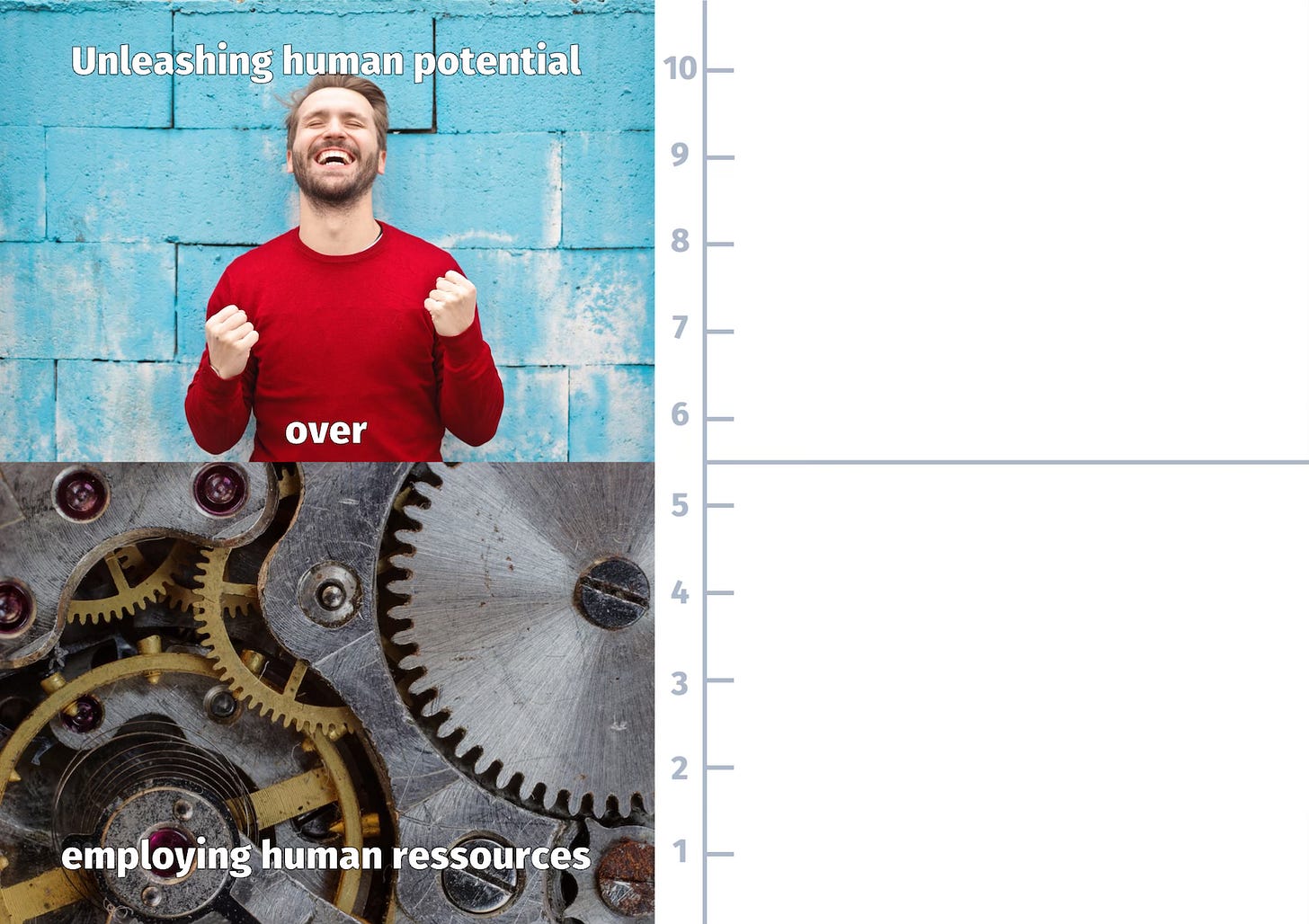
The first thesis in the workshop format
We can now ask three scaling questions:
- Where do I currently stand on this scale concerning this thesis?
- What am I already doing that makes me see myself at this level?
- What could I try out tomorrow and do differently to get to the next level?
The first question, the concrete positioning, only triggers the reflection and should not lead to competition. The next two matter much more. They invite people to think about their leadership behavior. The second looks at good practices, focusing on what is already there. The third guides action, focusing on what could be tried tomorrow–not to reach the full 10 but to improve a bit.
You need six movable walls or similar, on which to attach the six theses, printed in A1 format as shown in the image above. Sticky dots and sticky notes in two colors (green and yellow) serve as working materials. The complete template I usually use is available as a PowerPoint template in German and English on my homepage and can be used freely.
Workshop Format for Small Groups
In its simplest form, the workshop is for up to seven people who move from thesis to thesis and work together on the three scaling questions. The group starts with the first thesis. Each person receives a sticky dot and sticky notes in green and yellow. First, everyone reflects silently for five minutes on the scaling questions and notes the answers on green notes (practices already in place) or yellow notes (possible next concrete steps).
After this reflection, the group members present to each other their positioning, what has brought them there (green notes), and what could take them a step further (yellow notes). Each person gets five minutes at most. As in brainstorming, only questions for understanding are allowed. The point is not right or wrong or ranking but seeing what is already there and what steps could come next, and being inspired by the answers of others. Working on a thesis in a group takes twenty to thirty-five minutes.
The group then moves to the next thesis and repeats the process. After the sixth thesis, the workshop ends with a short feedback round in which each person describes their most crucial insights (“What have I learned here and now?”).
Parallel Group Variant
The same workshop can run with up to six groups in parallel, up to forty-two people in total, by rotating the groups through the six stations. The room must be large enough for the six groups to discuss at a table or on a movable wall without disturbing each other.
When the groups move to the next thesis, the moderator of the station can either replace the previous group’s poster with a new one or, as I prefer, briefly summarize the earlier results for the incoming group in the style of a World Café.
1-2-4-All for Larger Groups
For even larger groups, the “1-2-4-All” format from Liberating Structures works well. I also often use it for one or two selected theses as an interactive element in my keynotes on the Manifesto for Humane Leadership.
With 1-2-4-All, large groups can work on a common question: each participant alone for one minute, then in pairs for two minutes, and again in groups of four for four minutes. In the end, each group of four briefly presents its best idea or insight to everyone. Henri Lipmanowicz and Keith McCandless describe the exact process in their book.
The questions are based on the three scaling questions. After a brief introduction to the thesis, everyone writes down their answers on paper, for which three minutes should be set aside. The insights are then discussed and condensed, first in pairs and then in groups of four. At the end, each group of four shares its highlights with everyone.
This exercise takes twelve to thirty minutes per thesis, depending on the number of ideas and people. The first run-through often takes longer, because many ideas come up that also fit the other theses.